Hormone Belly: Causes and Ways to Reduce It
What is "hormone belly"? How insulin, cortisol, thyroid, sex hormones and dopamine interact to drive abdominal fat, and the habits that fix it.


- Hormones aren't the enemy — hormone imbalance is. Problems tend to arise when they're knocked out of sync.
- Different hormone systems tend to fail together. Each malfunctioning hormone affects another, directing fat towards the abdomen.
- Most of these hormones respond well to the same positive lifestyle levers. Sleep, stress, diet and nutrition all play an important role.
"Hormone belly" is a popular term for stubborn abdominal fat blamed on hormonal imbalance; it isn't a medical diagnosis. When people use it, they're usually pointing at one hormone in isolation
Hormones are the chemical messengers that control nearly every aspect of your metabolism. They manage your energy stores and control how fat is burned. They do this as part of the body's internal communication network.
When people talk about a "hormone belly," they're usually pointing at one hormone in isolation — insulin, cortisol, or low thyroid hormone. However, in reality, it's rarely just one.
Insulin, cortisol, thyroid hormone, the sex hormones, growth hormone, and even the brain's dopamine-reward system all interact with one another. Long-term disruption to any of these hormones can shift your metabolism toward storing more fat.
Insulin: The Traffic Controller
Thanks to the popularity of low-carb and keto diets, insulin has been cast as the villain for fat loss. More insulin equals more fat, right? However, this hormone is your friend if the rest of your body is functioning properly.
Think of insulin as your body's traffic controller. When youWhen you eat and your blood sugar rises, the pancreas releases insulin. Insulin then shuttles energy (in the form of glucose or "blood sugar") out of your bloodstream and into your cells, either for immediate use or to be stored for later.[1]
This process is natural, normal, and necessary. Without insulin, glucose would accumulate at dangerous levels in your body, as we see in diabetes. Beyond regulating blood sugar, insulin also promotes muscle growth. Insulin isn't inherently "bad". It's simply doing its job of managing your body's nutrient stores.
Insulin and fat loss: a complicated relationship
Insulin's primary role is regulating energy storage and use, which gives it an important role in fat loss. It directs the calories you eat toward muscle or fat tissue, and it governs the switch between burning fat and burning carbohydrate for fuel.
Insulin rises after meals (especially carbohydrate-rich ones) to promote storage, and falls during fasting and intense exercise so that stored fat and carbohydrate can be released and burned.
People with higher insulin "sensitivity" use energy more effectively and are generally considered more metabolically healthy. Your average blood sugar levels can serve as a rough proxy measure for how well your insulin hormone system is functioning.[2]
Contrary to popular belief, insulin doesn't "block" you from burning fat (certainly in healthy people anyway). Your body can burn fat and respond to insulin at the same time. The problem only arises when your insulin is persistently high. This is typically the result of consistently overeating, physical inactivity, and having poor metabolic health, or other conditions.
It isn't the brief insulin spikes after a meal or a hard workout that blunt fat burning — it's the sustained elevation in insulin that comes from repeatedly overeating sugary, calorie-dense food. This is what stops your body from responding to insulin as it should.
When insulin becomes a problem
Unhealthy lifestyle decisions cause insulin to become less effective at its "traffic controlling" function (i.e., managing your body's energy reserves). Your cells become less responsive to its effects, which is called "insulin resistance". Your body compensates for this by pumping out even more insulin to keep your blood sugar levels under control.
This excessive insulin production promotes fat storage (particularly around the midsection), makes breaking down and using fat more difficult, makes muscle building harder and muscle breakdown more likely, impedes your ability to exercise and increases your appetite.
Insulin isn't the enemy of fat loss — insulin resistance is.
Bad lifestyle habits raise insulin, which drives insulin resistance, which encourages more bad habits, which raise insulin further. It's a downward spiral that contributes to obesity, diabetes, and poor metabolic health. Breaking this cycle should be one of the first steps toward sustainable fat loss.[3]

Cortisol: The Link Between Stress and Body Fat
Cortisol (the "stress hormone") is also misunderstood. During stressful situations, cortisol spikes and mobilises stored energy, providing "fuel" for immediate use
But (like insulin), when cortisol is released continually, it increases fat storage — particularly around the abdomen and internal organs. It increases muscle breakdown, disrupts sleep quality, and dulls the effects of insulin, which causes insulin resistance.[4]
Cortisol itself isn't your enemy; it's there to protect you and keep your body functioning. It gets a bad reputation because of what it does and because it tends to increase in people who are stressed, obese, or metabolically unhealthy.
But it is there to respond to a potential problem; it doesn't cause it. That said, lower cortisol levels are generally better for fat loss, although some cortisol is still essential.
 Dr. Robert Davies

Thyroid Hormone: The Metabolic Thermostat
Thyroid hormones regulate how much energy you use. They control your body temperature and govern how you respond to changes in energy supply or demand.
The two thyroid hormones (T3 and T4) control many of the body's most energy-intensive processes. So they can substantially adjust your metabolic rate up or down as and when needed. When energy intake is low, thyroid hormone levels fall, which slows metabolism and helps your cells conserve energy.[5]
People with low thyroid hormone ("hypothyroidism") struggle to raise their metabolic rate to meet demand. This is often associated with obesity and difficulty losing fat. Whereas those with overactive thyroid function ("hyperthyroidism") tend to lose weight and may struggle to exercise effectively, recover and adapt to training.[6]
Low intake of calories, carbohydrates, and certain micronutrients (like iodine, selenium, and zinc) can impair normal thyroid function even without any underlying thyroid disease. This is one of the reasons why crash diets or severe calorie restriction can strangely end up making fat loss harder in the long run.
Sex Hormones: Testosterone and Estrogen
Testosterone and estrogen are best known for sexual development and reproduction (and muscle growth). But they also affect fat metabolism (that's storage, breakdown, and use of fat) in both men and women.
Testosterone promotes muscle growth. It increases the amount of energy you burn and the amount of fat you use for fuel. It also blunts some of cortisol's negative effects on your muscle tissue. Differences in testosterone levels are thought to be one of the main reasons men tend to gain muscle and lose fat more quickly than women do.[7]
Conversely, estrogen promotes fat storage around the hips and thighs (the "gynoid" or "pear" shape) while supporting insulin sensitivity and burning carbohydrate for energy.
Fluctuations in estrogen across the menstrual cycle are thought to influence fat loss, too. Both estrogen and progesterone affect water retention, appetite, energy levels, fat metabolism, exercise performance, and food preferences in women throughout their monthly cycle.
Fat loss may feel harder during the luteal phase, when rising progesterone increases appetite and water retention. However, evidence for actual changes in fat metabolism rates across the cycle remains inconsistent.
The menopause brings about substantial hormonal changes in older women. Declining estrogen and testosterone lower metabolic rate and muscle mass, while also increasing abdominal fat.
 Dr. Robert Davies

Growth Hormone
Growth hormone is often linked with muscle, but it also affects fat tissue directly. It promotes fat breakdown while preserving muscle during calorie restriction.
The effects of growth hormone are most pronounced while you sleep, which may help explain why poor sleep can derail fat loss efforts. Exercise also stimulates release of growth hormone, which may contribute to muscle preservation and fat loss during a calorie deficit.[7][8]
Like the sex hormones, growth hormone levels peak in your teens and decline gradually through adulthood (sometimes known as the "somatopause"). Consistently high insulin levels are thought to further suppress growth hormone (see how all these hormones link to one another!). This is a possible explanation for why older adults and those with insulin resistance often find losing fat difficult.
Dopamine: The Motivation Molecule
Beyond the hormones that manage your energy directly in your body, one neurotransmitter shapes how (and how much) you eat in the first place.
Dopamine is one of the brain's key "neurotransmitters" that is involved in motivation, reward, and learning. It strongly influences our behaviour by motivating us to seek out, expect, and respond to food, particularly calorie-dense, junk food.
Despite its reputation as the "pleasure hormone", dopamine isn't really a "happiness chemical". It's more about motivation and anticipation than pleasure itself. Dopamine creates drive! It's the feeling of "wanting" or "craving" something, which is different from the feeling of just "liking" it.[9]
Dopamine increases in anticipation of eating before you eat. It continues to be released while you eat, but it's the anticipation that drives food-seeking.. Palatable, calorie-dense foods trigger particularly large increases in dopamine, even when you're not especially hungry or in genuine need of food.
The dopamine reward system evolved over millions of years to help find food when it was scarce. But it's now operating in an environment of near-limitless calorie-dense food. Whole foods like fruit, vegetables, and lean protein only stimulate moderate amounts of dopamine. Whereas ultra-processed foods appear to trigger much greater dopamine activity, effectively "hacking" the system to maximise reward for eating it.[10]
Dopamine "tolerance" may develop. Repeated exposure to highly rewarding foods appears to blunt the brain's reward response, so more (or more intense) stimulation may be needed to get the same sense of reward. It resembles patterns seen in other addictions, though "food addiction" remains a debated concept.
Whatever the label, it creates an environment where unhealthy, dopamine-rich foods become more appealing while healthier options lose their attraction.[11]
The Dopamine Response Cycle
Seeing, smelling, or even thinking about certain foods triggers dopamine rewards. It peaks, it drops (sometimes below baseline levels), and then it triggers the next cycle of trying to find dopamine-releasing foods. This cycle is thought to underlie repetitive food-seeking behaviour and a preference for unhealthy, energy-dense foods in people who struggle to manage their weight.
Viewing the modern world through this "food = dopamine" lens reframes a lot of everyday cues. Think about it: advertising, social media food content, cooking videos, restaurant displays, the smell of a bakery, the birthday cakes, the "cheat meals," the sweets by the checkout, the Friday pizza and beer at the office.
It's worth asking why certain foods are chosen specifically as rewards, celebrations, or comforts when you're tired or stressed — and why some foods are heavily marketed and made maximally available, while others aren't.[12][13]
What are they really selling: food, nutrients, things that will keep you healthy, or something else?
Stress, Emotions, and Food Reward
Stress, fatigue, sleep deprivation, social isolation, and low mood are all associated with greater food-reward-seeking. And today, food is cheap, accessible, and easy to obtain compared to most other rewards, making it the easiest one to reach for.[14]
Repeated over time, this builds a learned connection between certain foods and certain emotional states. It is a dopamine-driven response that can skew decision-making and helps explain why emotional eating becomes ingrained and hard to stop.
Some people are more sensitive to dopamine than others. There are both genetic and environmental (life experience, current circumstances) components to it. This means management of it usually requires a personalised approach. People who develop binge-eating or emotional-eating patterns are often trying to navigate stressful environments, but also have access to, and a preference for, junk food.
The Hormones That Control Fat Loss and Obesity
There are more hormones involved than the ones we've mentioned in this article. Here's a summary of other key hormones and signalling molecules and what they do.
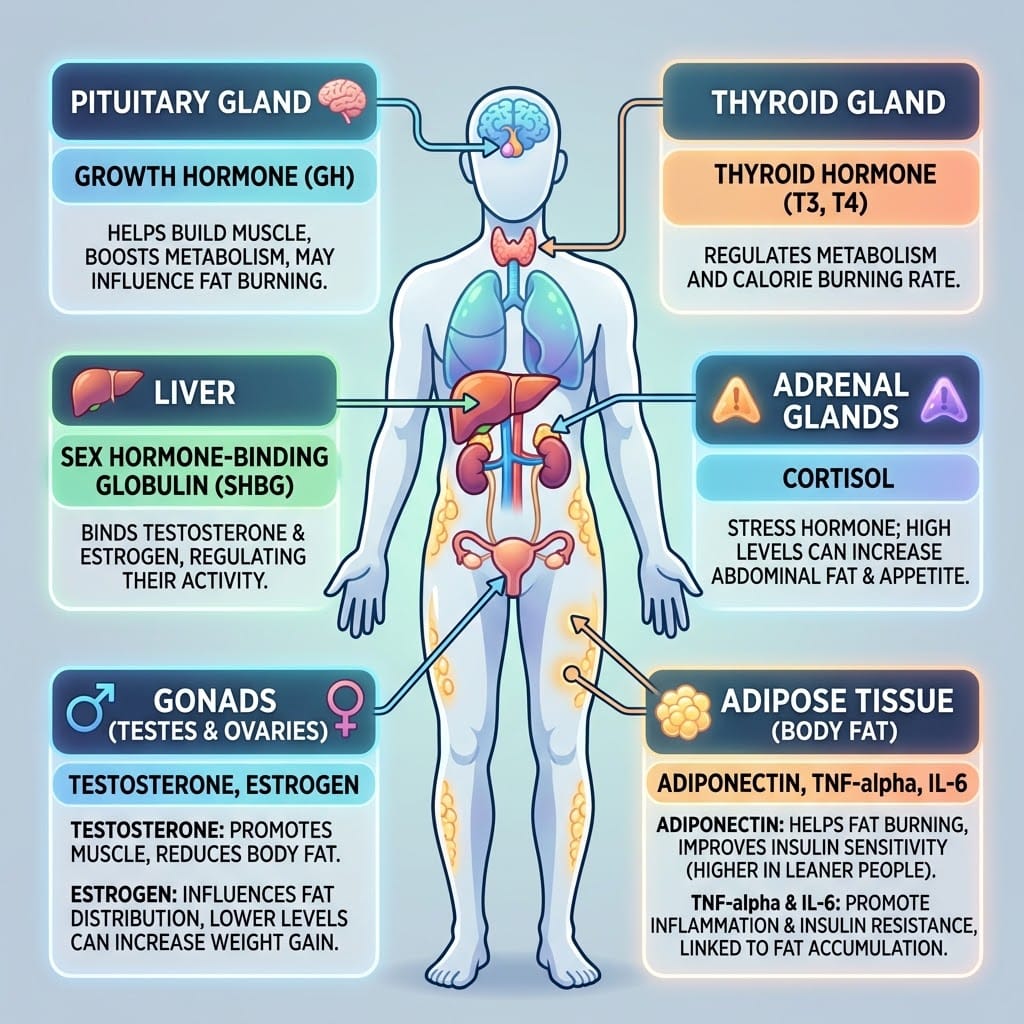
- Thyroid Hormone: Increases energy expenditure and the amount of fat you burn.
- Testosterone: Decreases body fat percentage and determines where you deposit fat around your body.
- Estrogens: Promote fat storage around the hips and thighs; low estrogen (e.g., after menopause) shifts fat towards the abdomen.
- Growth Hormone: Decreases body fat and increases fat burning.
- IGF-1: Stubbornly high levels are linked to inflammation and insulin resistance, whereas short bursts released during exercise increase fat burning.
- Cortisol: Increases fat storage, particularly around your midsection.
- Adiponectin: Increases fat burning.
- TNF-alpha: Raised in people who are obese. It promotes inflammation and insulin resistance.
- IL-6: Increases fat storage and decreases fat burning.
- SHBG: Binds sex hormones, lowering their active (free) levels. Low SHBG is associated with obesity and insulin resistance.
Practical applications: Healthy hormones = healthy body weight
The encouraging news is that most of the hormonal systems covered here: insulin, cortisol, thyroid, growth hormone, and dopamine respond well to the same handful of basic lifestyle changes.
You don't generally need to optimise one hormone system at a time, or at the expense of another one.
#1. Pay attention to meal content, not just the calories
Fibre, vegetables, wholegrains and healthy fats produce a smaller insulin response than refined carbohydrates and sugary foods. Protein also raises insulin, but it's very filling, which makes it easier to eat less overall. Eating more slowly may also help blunt the post-meal surge.
#2. Consider meal timing, but don't overthink it
The timing and frequency of your meals affect insulin sensitivity too. Though this is not as important as the total amount or what you eat.
Eating earlier in the day, spreading calories across the day, or incorporating periods of fasting can improve insulin sensitivity for some people. But the priority should be a sustainable pattern that actually fits your schedule and lifestyle.
#3. Move regularly
Exercise is among the most effective insulin sensitisers. More insulin-sensitive muscle means your body needs to release less insulin. Exercise improves your muscle's insulin sensitivity regardless of how much muscle you currently have. Exercise also stimulates the release of growth hormone and testosterone too.[15]
Even small amounts of exercise can be effective. A 10-minute walk before or after eating can meaningfully reduce the blood sugar rise after that meal (and the insulin needed to manage it). And a decent resistance exercise session can improve insulin sensitivity for a day or two after training.[16]


#4. Protect your sleep and manage stress
Poor sleep and chronic stress impair insulin sensitivity (via more cortisol being released). Poor sleep blunts the nocturnal growth hormone release, which helps preserve muscle and burn fat during a deficit.
Aiming for 7–9 hours of quality, uninterrupted sleep and keeping chronic stress in check supports insulin, cortisol, and growth hormone release all simultaneously.[17]


#5. Manage your food environment, not just your willpower
Dopamine-driven cravings are heavily shaped by visual, olfactory (smell), and emotional cues. So, change your environment by reducing exposure to advertising and easy access, and rethink which foods you associate with reward or comfort.
This tends to be more effective than relying on self-control alone. Complete abstinence from food pleasure works for a few, but not most people.
Planned indulgences, social eating, and learning to make healthy meals genuinely enjoyable are more sustainable "controlled food-rewards" that are pleasurable, but without triggering unhealthy overconsumption eating patterns.
#6. Know when lifestyle isn't enough
Medical treatments such as medication or surgery may be effective (or necessary) for some people, mainly those with thyroid dysfunction, severe insulin resistance, or other clinically diagnosed hormonal conditions. If you have persistent symptoms (e.g., unexplained weight gain, fatigue, feeling cold, irregular periods), ask your doctor to test for them.
However, for most people, moderate, sustainable lifestyle correction across sleep, stress, movement, and food quality addresses the majority of what drives hormone belly and derails fat loss attempts.
Bottom Line
"Hormone belly" isn't really about one rogue hormone — it's what happens when several interconnected "hormone systems" drift out of balance with one another. And it's usually driven by the same (boring but obvious) underlying causes.
Insulin, cortisol, thyroid hormone, the sex hormones, growth hormone, and the dopamine-reward system all play necessary, protective roles individually. None of them is the enemy on their own.
The goal isn't to eliminate or "fix" any single hormone, but to support the whole system through a small set of consistent habits: good sleep, regular movement, thoughtful meal composition, and a food environment that works with your biology rather than against it.
Sources
- Wilcox. Insulin and insulin resistance. Clin Biochem Rev. 2005 May;26(2):19-39. PMID: 16278749
- Galgani & Ravussin. Energy metabolism, fuel selection and body weight regulation. Int J Obes (Lond). 2008 Dec;32 Suppl 7(Suppl 7):S109-19. PMID: 19136979
- Freeman et al. Insulin Resistance. [Updated 2023 Aug 17]. In: StatPearls [Internet]. Treasure Island (FL): StatPearls Publishing; 2026 Jan-. Available from: https://www.ncbi.nlm.nih.gov/books/NBK507839/
- Douyon & Schteingart. Effect of obesity and starvation on thyroid hormone, growth hormone, and cortisol secretion. Endocrinol Metab Clin North Am. 2002 Mar;31(1):173-89. PMID: 12055988
- Rosenbaum & Leibel. Adaptive thermogenesis in humans. Int J Obes (Lond). 2010 Oct;34 Suppl 1(0 1):S47-55. PMID: 20935667
- Ylli et al. Endocrine Changes in Obesity. [Updated 2022 Sep 6]. In: Feingold KR et al., editors. Endotext [Internet]. South Dartmouth (MA): MDText.com, Inc.; 2000-. Available from: https://www.ncbi.nlm.nih.gov/books/NBK279053/
- Kraemer & Ratamess. Hormonal responses and adaptations to resistance exercise and training. Sports Med. 2005;35(4):339-61. PMID: 15831061
- Leproult & Van Cauter. Role of sleep and sleep loss in hormonal release and metabolism. Endocr Dev. 2010;17:11-21. PMID: 19955752
- Berridge. Food reward: brain substrates of wanting and liking. Neurosci Biobehav Rev. 1996;20(1):1-25. PMID: 8622814
- Schulte et al. Which foods may be addictive? The roles of processing, fat content, and glycemic load. PLoS One. 2015 Feb 18;10(2):e0117959. PMID: 25692302
- Volkow et al. Obesity and addiction: neurobiological overlaps. Obes Rev. 2013 Jan;14(1):2-18. PMID: 23016694
- Volkow et al. The dopamine motive system: implications for drug and food addiction. Nat Rev Neurosci. 2017 Nov 16;18(12):741-752. PMID: 29142296
- Boyland et al. Association of Food and Nonalcoholic Beverage Marketing With Children and Adolescents’ Eating Behaviors and Health: A Systematic Review and Meta-analysis. JAMA Pediatr. 2022;176(7):e221037. PMID: 35499839
- Adam & Epel. Stress, eating and the reward system. Physiol Behav. 2007 Jul 24;91(4):449-58. PMID: 17543357
- Bird & Hawley. Update on the effects of physical activity on insulin sensitivity in humans. BMJ Open Sport Exerc Med. 2017 Mar 1;2(1):e000143. PMID: 28879026
- Nedeltcheva et al. Insufficient sleep undermines dietary efforts to reduce adiposity. Ann Intern Med. 2010 Oct 5;153(7):435-41. PMID: 20921542
- Spiegel et al. Impact of sleep debt on metabolic and endocrine function. Lancet. 1999 Oct 23;354(9188):1435-9. PMID: 10543671