Big Belly But Thin Legs: The Candy Apple Phenotype
Why do men develop a firm belly with thin limbs? What is the hidden metabolic risks of this body shape, and how to reverse it.


- A firm, protruding abdomen paired with thin arms and legs reflects the buildup of fat inside the abdominal cavity.
- Eating too much, moving too little and having low muscle mass overload and overwork your vital internal organs, causing health issues.
- Reversing it requires you to change your body composition. Exercise, adequate protein and other healthy lifestyle habits are key to solving it.
Body fat doesn't accumulate the same way for everyone. The most obvious example is how men and women put fat on differently: the classic apple shape (waist and abdomen) for men versus the pear shape (hips and thighs) for women. How and where you put on fat is determined by your hormones, genetics, and lifestyle, and it also affects your health in different ways.
Where you store fat matters just as much as how much fat you carry. So, there are a few different "subtypes" of obesity. In this article, we are going to look at one of the highest-risk types, what we call "Candy Apple Phenotype".
Why men get a big belly but still have thin limbs
Walk around anywhere in the West, and you'll notice a very common body shape in middle-aged and older men. They tend to carry a large but firm, protruding belly that is shaped like an apple or beer keg. Yet, their arms, legs, shoulders and even face appear normal, or sometimes thin. In other words, their belly doesn't match the rest of their body.[1]
This has been observed for a while, often laughed off as a "beer gut" or just a sign of getting older. However, this unique type of body shape is a serious indicator that things aren't healthy inside. It's a bit more serious than just carrying a few extra pounds.
What we are really seeing is a metabolic health issue. One where the muscle in those skinny legs and arms is not working well, all while you're packing dangerous fat deep inside your abdomen and around your vital organs.
Physiology behind the beer gut
With "typical" obesity, fat accumulates evenly under your skin across your entire body: arms, legs, back, mid-section and face. You can easily see and pinch this type of fat with your fingers — and it wobbles when you jump up and down. However, men with firm bellies and thin limbs have a different type of obesity.
The candy apple phenotype is similar to a distinct type of obesity called "sarcopenic obesity", which means having high body fat ("typical obesity") occurring alongside a low amount of muscle ("sarcopenia"). Both of these things are bad in their own right, so having both of them together is doubly bad for your health. It's also sometimes referred to as "skinny-fat", "thin-fat" or "normal weight central obesity".[2][3]
The candy apple phenotype isn't quite either of these, as it seems to occur more commonly in men. People with it can be normal body weight or obese, and have a low or normal amount of muscle tissue.
It's not about scale weight or the amount of fat or muscle you have. It's about body shape, where the fat is distributed. It's where the body stops depositing excess energy in the muscle and directs it deep into the abdomen.
The "Candy Apple Phenotype" Explained
We call it this because the body shape resembles an apple on a stick, or a candy apple. The apple is the apple-shaped mid-section that's supported by thin limbs (the wooden stick).
Beyond the physical shape, we call it the "Candy Apple" phenotype, as the candied apple represents something that should be naturally healthy (i.e., a fresh apple), but it is covered in something unnatural and unhealthy (i.e., the candy layer).
How do you know if you have it?
"Candy apple phenotype" isn't a formally classified health condition with a defined clinical diagnosis — it's a coined term. But there are some telltale signs that you may have central obesity, which is a closely related recognised condition.
- Waist Circumference: Measure your waist at belly-button level: for men, 94 cm (37 in) or more signals increased health risk and 102 cm (40 in) or more signals high risk. Another useful check is whether your waist is more than half your height, which can flag risk even when your weight looks "normal".
- Type of "adiposity": A belly that feels firm rather than soft and pinchable, alongside slim arms and legs, suggests much of the fat is visceral, so ask your doctor about clinical tests, since waist size alone can't show what's really happening inside.
How and Why It Happens
The reason why abdominal fat can increase while arms and legs don't is due to a "feedback loop" between a few different organs in your body: your muscles, liver, fat cells, brain and the abdominal cavity itself.
Muscle is an energy sponge
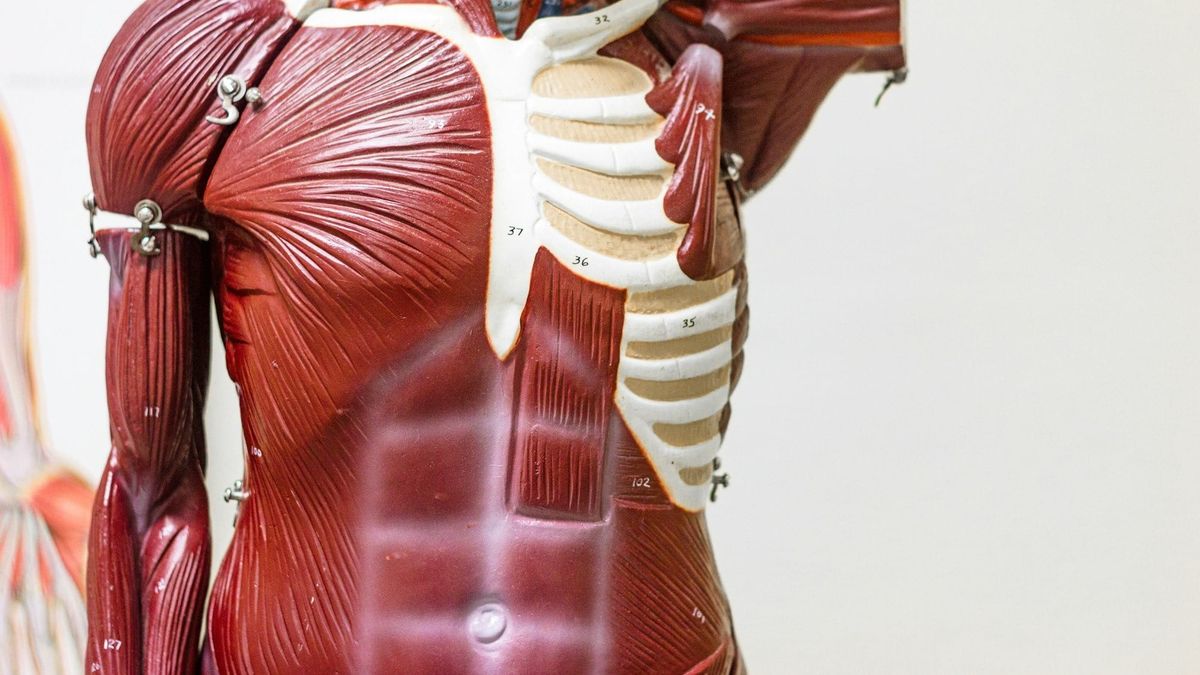
By mass, your muscles are the largest organ in your body by mass, but they are not just used for moving around and lifting heavy objects. You should think of muscles as a giant sponge (or buffer) for excess calories. If you eat too many calories, it has to go somewhere. If you've a lot of big healthy muscle (a "big sponge"), it can take this sugar from your blood and store it.
If your muscle can't do this, either because it is too small (a "small sponge"), unhealthy or inactive (an "old sponge"), these calories will probably end up being stored as fat or possibly in worse places, which is what happens in a lot of liver diseases, muscle diseases and uncontrolled diabetes![4]
If you eat too many calories for your body to handle, it will overload your muscle, liver and pancreas, which will push those extra calories into your fat tissue through a process called de novo lipogenesis. Your body doesn't do this because it wants to — it is an inbuilt safety mechanism to keep you healthy. Storing extra fat is not good, but it's a lot better than dangerously high blood sugar levels.

Fat cell storage capacity and spillover
But this isn't the end of the story. Where does all this newly created fat go? Under normal conditions, your body stores those extra calories nicely and safely in your "subcutaneous" fat cells under your skin that are distributed around your body (e.g., arms, legs, and hips). However, the fat in these areas has a limited storage capacity.[5]
Once the fat storage capacity in your limbs is full, which varies person-to-person, new fat that's created has to go elsewhere. It "spills over" into less healthy areas to store fat that aren't really designed to store large amounts. It will build up inside your abdominal cavity, around and inside your organs, where it affects how they work. Not good! It's called visceral fat.
Why does the belly feel hard and firm?
The answer probably lies in a combination of internal pressure (caused by too much fat) combined with muscle wall failure (caused by weakened muscles).
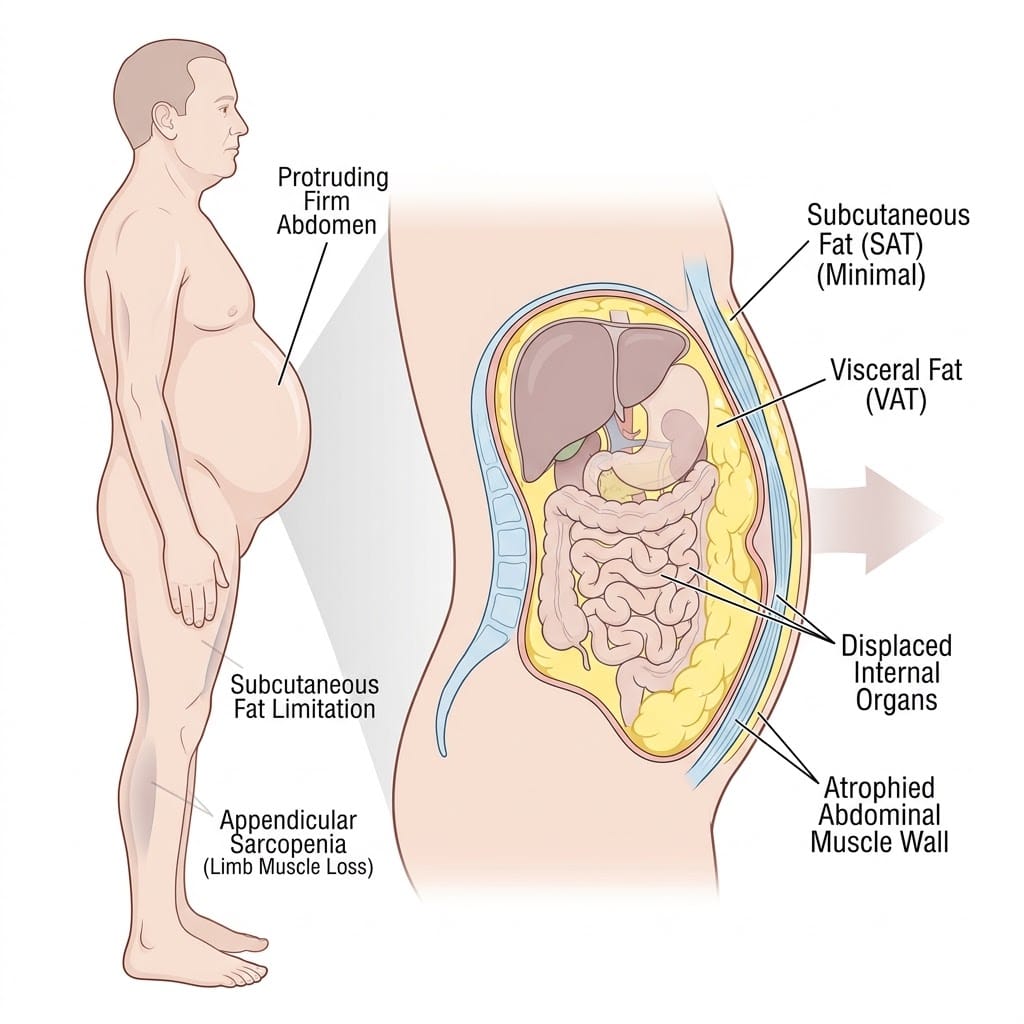
Visceral fat stores itself behind the abdominal wall, wrapping tightly around internal organs. As it expands, it creates high intra-abdominal pressure, pushing outward against the abdominal muscles from the inside out.
At the same time, the muscles in the front and sides of the torso are weakened as they become infiltrated with fat cells. The weakened muscle then stretches outward under pressure, forming a rigid, dome shape that's firm, but not wobbly. Most of the fat is under the muscle, so you can't easily pinch it with your fingers.
What Causes Candy Apple Phenotype?
Hormones
Testosterone, estrogen and cortisol are the three primary hormone shifts that are behind the candy apple phenotype.
Cortisol is the body's main "stress hormone". High cortisol levels, through stress or genetics, encourage both increased fat storage and muscle wasting at the same time. So, it shifts the balance, making it more likely to end up with more fat tissue and less muscle.
And what's most interesting is that this can happen "locally", meaning some of the fat tissue in your abdomen creates the conditions to make lots of cortisol there, so it can absorb proportionately more fat, compared to elsewhere in your body.[6]
The second hormone change is to do with age. This is why it seems to occur a lot in middle-aged and older men. Once they reach their 30s and 40s, a lot of men experience decreases in testosterone, which plays an important role in controlling how much muscle and fat you have. When your testosterone system stops working as well, it makes it more difficult to hold on to your muscle.
Add to this the fact that having too much abdominal fat can lower your testosterone levels even further. This happens because fat tissue releases more of another substance called aromatase, which goes on to convert what little testosterone you have left into estrogen! This then goes on to encourage more fat to be stored around your midsection, another doom-loop.[7]
As your visceral fat cells are loaded with energy and start to expand, they send out a stress signal. So, immune cells then start to gather around these stressed fat cells and release molecules that cause inflammation. Too much of this inflammation can disrupt how your muscle functions and prevent it from growing. It also goes on to fuel the expansion of the fat in your abdomen even more. Stress, ageing, inflammation and some other unhealthy lifestyle factors accelerate it.[8][9]
 Dr. Robert Davies
Genetics
Genes also play a role in deciding where your body stores fat. As we said before, the different fat storage patterns between men and women are genetically determined. However, there are also specific fat storage patterns seen in other populations (e.g, "Indian Pot-Belly"), which indicates that there is a genetic component to it.
Scientists have argued for decades about where this trait has come from, and there is currently no clear consensus. However, most scientists do agree that the increased availability of high-calorie food and reduced labour demands made these traits a clear disadvantage that increases your chances of central obesity and metabolic disease.
Daily Lifestyle Triggers
While ageing and genetics form the foundation, it is everyday habits that matter. Not every man who ages or is genetically predisposed to it goes on to have a candy apple phenotype! We think three main lifestyle decisions drive it.
First, excess alcohol intake. Drinking too much speeds up muscle loss. At the same time, it preoccupies your liver, stopping it from processing fat. The extra calories from alcohol (and the type of food you eat when you drink too much alcohol) get routed into your liver and abdomen, where they are stored as fat. This is where the "beer-belly" and "alcohol-related" fatty liver monikers come from.[10]
Second, diets high in added (table) sugar are linked to abdominal fat. Added sugars consumed in large amounts (e.g., from ultra-processed foods and sugar-sweetened drinks) overload your liver and speed up the production of fat that gets deposited in your abdomen and around your organs.[11]
Third, prolonged sitting and not exercising enough lowers the amount of calories that you burn and exacerbates loss of muscle mass. Over time, if your muscles shrink, you go on to burn even fewer calories (at rest and during exercise), and this also reduces the amount of energy they can store. So, those extra calories go on to get stored in your abdomen.


Major Health Risks Linked to Central Obesity
The health risks associated with "typical" obesity are well known. However, there are some specific health risks linked to the candy apple phenotype.[12][13][14][15]
- Type 2 diabetes: inflammation, an overloaded, overworked liver, lower muscle mass and reduced capacity to remove excess blood sugar are a recipe for developing "insulin resistance" and then type 2 diabetes.
- Fatty liver disease: excess calories accumulating as fat in and around your liver can lead to non-alcoholic fatty liver disease, liver inflammation, scarring and liver cirrhosis, which stops your liver from working properly.
- Cardiovascular disease: the links between obesity and heart disease are well known. But even if you are normal body weight, central obesity is linked to cardiovascular disease. The inflammatory molecules released from visceral fat can stiffen your blood vessels, increase blood pressure, LDL cholesterol and triglycerides.
- Pain and mobility: Carrying the excess weight around your mid-section on skinny legs can increase stress on your hips, knees and lower back. Over time, this can go on to cause balance problems, risk of falls and physical frailty.