Why the Scale Lies About Fat Loss — And Better Ways to Track Progress
A look at why BMI and body weight can be misleading and better ways to measure fitness and health.

- BMI and scale weight can't distinguish fat from lean mass. For anyone exercising, they're often misleading and sometimes flat-out wrong.
- Waist circumference is a simple, practical alternative that better reflects health risk and isn't skewed by the amount of muscle that you have.
- Progress photos, clothes fit, strength improvements, and blood markers tell a more complete story. Use multiple measures, not just one number.
There are more important things that can be measured beyond the number on a scale, including body composition, strength gains, and changes in how your clothing fits. This article explains practical, evidence-based methods to track progress better. You may have heard that weightlifting and building muscle are good for your health and for losing fat — that’s undeniably true.
Why the scales and BMI are unreliable measures of health
So, you’ve been going to the gym consistently for months. Your clothes fit better, you notice it in the mirror, you feel stronger, and your friends are even making comments about it.
But when you step on the scale, the number has barely moved — or worse, it's gone up. Frustrated, you wonder if all your hard work has been for nothing: “I’ve not even lost any weight”, you say to yourself. Here's the real truth: the scale is lying to you.
Therefore, so is your Body Mass Index (BMI) if your doctor bothers to look at that sort of thing. These popular metrics, while simple to calculate and widely used, are fundamentally flawed when it comes to what health and fitness progress actually look like. We’ll explain how and why these measurements fail, and what you should think about looking at instead.
Why is BMI a poor measure of fat loss?
A 200-year-old tool that never fit
BMI was developed in the 1830s by the Belgian statistician Adolphe Quetelet. It wasn't created to measure how fat or how fit a person was; it was created to study “population” trends across thousands of different people all at the same time.
The formula is deceptively simple: take your body weight in kilograms and divide it by the square of your height in meters. A BMI over 30 classifies you as obese, while a BMI over 25 means you're overweight. While BMI correlates reasonably well with disease risks across “populations” (i.e., thousands of people all analysed together), it has flaws when it is used at an individual level.
The fundamental issue?
BMI cannot distinguish between fat mass and 'fat-free mass', which also includes muscle, bone, organs, and water. It treats all weight equally, when clearly (from a health perspective) it's not. Gaining one kilogram of muscle does not lead to the same health outcomes as gaining one kilogram of fat.
In fact, in most cases, they have opposite effects on your health. Gaining muscle is nearly always good for your health. Whereas most of the time, gaining fat is bad. Consider this: if you gain 5 kilograms of healthy muscle through strength training, this is something nearly every scientist and medical expert would agree is beneficial for your health.[1]
However, despite the applause, your BMI will actually increase, suggesting you've become less healthy! The one exception is that if you're underweight to start with, which won't apply to most people, so this article is just for those who are looking at maintaining or losing weight, rather than gaining it.
The exercise paradox
This limitation is problematic for people who are exercising regularly, especially weightlifting, as it’s particularly efficient at stimulating muscle growth. Over the course of a resistance training programme, you can typically expect increases in your muscle mass to occur alongside decreases in fat mass — a highly desirable outcome.
Yet because changes in muscle mass and BMI are positively correlated with each other, BMI is completely inappropriate for assessing progress in people who are exercising. If you’re thinking this doesn’t make sense, you’re right. Yes, the medical community will advise you to exercise for weight loss, then, at the same time, use a flawed measure to assess your progress. Bizarre!
Let me illustrate with a real-world example. Imagine an obese person weighing 100 kg (220 pounds) who is 1.8 meters (5 feet 11 inches). Their body fat is 40% (40 kg of fat and 60 kg of fat-free mass), and they have a BMI of 31 31 kg/m². Over several months of exercise training, they go on to lose 5 kg (11 lbs) of fat while simultaneously gaining 5 kg (11 lbs) of muscle — an excellent outcome.
What happens to their BMI? Absolutely nothing. It remains at 31. They’re still classified as “obese” even though their body fat percentage has dropped from 40 to 35%, and their health will have improved dramatically.
Now, worse: imagine that they only lost 5 kg of fat; they would have reduced their BMI from 31 to 29. They would no longer be defined as obese (just overweight), despite not losing a single gram of fat, and their body fat would have only dropped from 40 to 37%.
It can technically get even worse. Imagine that person skips the gym, lies on their sofa and bed, and loses 5 kg of muscle. They’ll have been moved out of the obese category by their doctor, but their body fat would have gone up from 40 to 42%.
These contradictions reveal why BMI fails as a measure for monitoring progress for people who are exercising. Any reduction in fat or body fat percentage can be completely offset by simultaneous increases in muscle mass. This makes BMI changes misleading or even discouraging for people doing exactly what they should be doing (from a health perspective).
Beyond fat and muscle: water and carbohydrate
The problems with scale weight extend even further. Your body weight fluctuates significantly based on factors that have nothing to do with gaining or losing fat.
Even if you’re drinking the same amount of water every day, the amount of water in your body can vary by several pounds day-to-day based on your sodium intake, hormones, inflammation, menstrual cycle, stress, and medication.
After eating carbohydrate-rich meals, your body stores carbohydrates for energy (as “glycogen”) in your muscles and the liver. Each gram of glycogen stored in your muscle takes 3–4 grams of water with it. This is why low-carb diets produce rapid initial “weight loss” after a few days — it's primarily water and glycogen, not fat.[2]
Starting a new exercise program often causes temporary “water retention” in your muscles to repair and adapt. This means you could be burning fat while the scale stays the same or your weight even increases due to water weight — another way the scale misleads you about your actual progress.


Does BMI accurately reflect your health?
BMI also fails to account for where fat is stored, which profoundly affects health risk. Two different people with identical BMIs can have vastly different amounts of fat and health profiles. One person might carry most of their fat subcutaneously (under the skin), while another may have a lot of dangerous visceral fat around internal organs.
Visceral fat is metabolically active and strongly associated with cardiovascular disease, type 2 diabetes, and other health complications. Subcutaneous fat, while not ideal in excess, is relatively benign. BMI treats these two types of fat equally, missing a crucial distinction for health.
The concept of "metabolically healthy obesity” or “fat but fit” illustrates this further. While uncommon, some people are classified as obese by BMI but have normal health markers — maybe because they exercise regularly and have a lot of muscle despite also carrying extra fat.
Given these substantial limitations, what should you track to assess genuine health and fitness progress? The correct answer depends on your goals, resources, and preferences, but there are several alternatives to consider that are more informative than BMI or scale weight alone. We’ll start with the simplest, most accessible methods you can use at home first.
Waist circumference: simple and effective
Waist circumference offers a practical alternative that better predicts health risk than BMI. A waist measurement over 40 inches (102 cm) for men or 35 inches (88 cm) for women — or more than half your height, regardless of sex — indicates abdominal obesity and increased risk of disease.[3]
Why this works better: Waist circumference correlates strongly with abdominal fat and visceral fat. It also remains relatively unaffected if you gain muscle from exercise (unlike BMI). For people participating in exercise programs, muscle gains primarily occur in the upper body and limbs. So, hip and waist measurements, away from these sites, can provide a viable, accurate alternative to BMI.
How to measure waist circumference correctly:
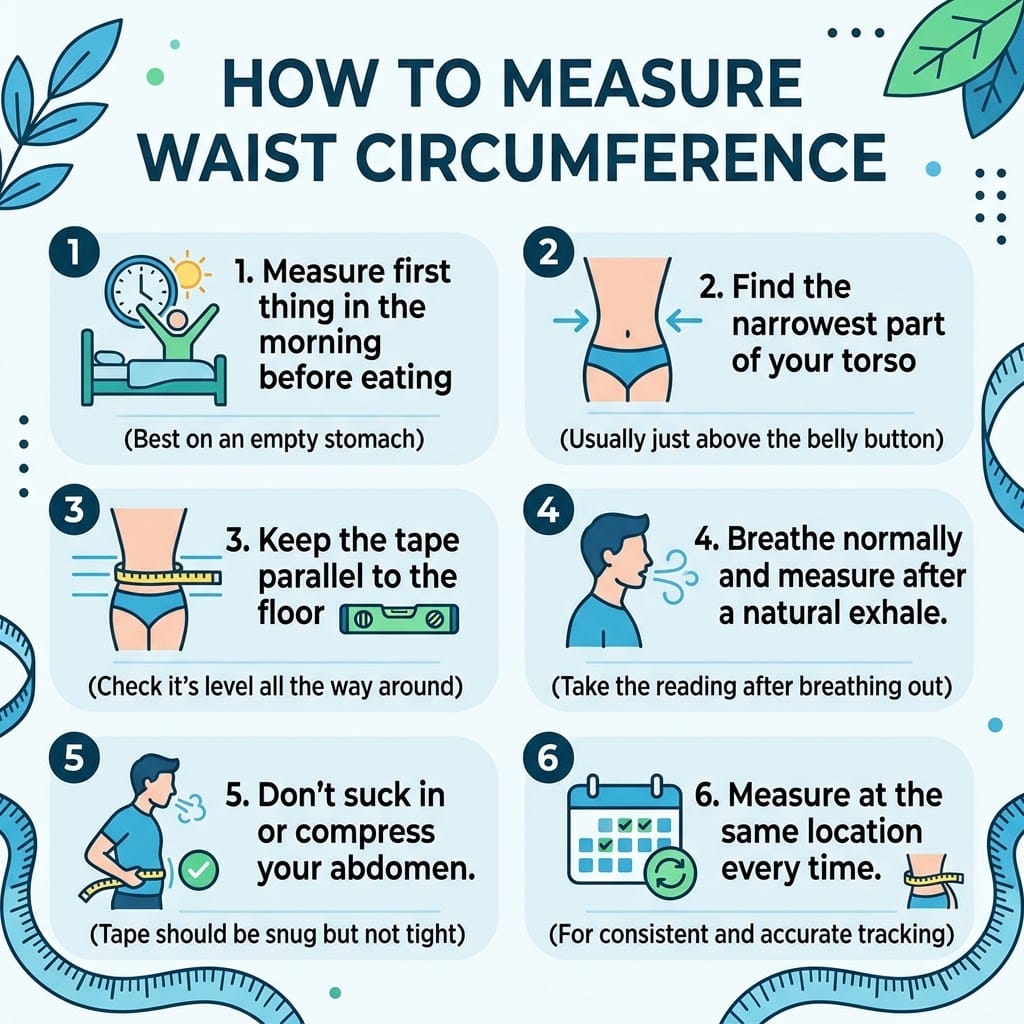
- Use a flexible measuring tape, not one you use for measuring the skirting board.
- Measure first thing in the morning before eating
- Find the narrowest part of your torso (usually just above the belly button)
- Keep the tape parallel to the floor
- Breathe normally and measure after a natural exhale
- Don't suck in or compress your abdomen
- Measure at the same location every time
Track this measurement weekly. A cheap measuring tape may be the most valuable progress-tracking tool you can buy. Although it’ll be less accurate, the fit of your trousers or belt will tell you the same story.
Progress photos and measurements
Never underestimate the power of visual documentation. There’s a reason why marketers use the before-and-after photos to sell their products. Progress photos, taken under consistent conditions, can provide good visual evidence of body composition changes that scales and BMI may miss.
How to take effective progress photos:
- Wear the same minimal clothing each time (swimsuit or underwear)
- Use the same lighting and location
- Take front, side, and back views
- Shoot at the same time of day (morning is ideal)
- Use the same camera distance and angle
- Don't judge day-to-day — compare photos months apart
To confirm what you think you’re seeing in the photos, combine them with body measurements (other than your waist) using your measuring tape. Measure your chest, upper arms, thighs, hips, or calves. These measurements can hint at where you're losing fat or building muscle, providing a more complete picture than a single number can.
The bigger picture: other measures
Health isn't just about how you look or what you weigh — it's about what your body can do. Tracking some simple “performance” metrics can provide some good supporting information and additional motivation for you. Examples include:
- Strength gains: How much weight can you lift? Are you progressing on key exercises?
- Endurance: How far or long can you run, walk, cycle, or swim?
- Function: Can you play with your kids longer? Carry more groceries? Get off the floor more easily?
- Energy levels: How do you feel throughout the day?
- Sleep quality: Are you sleeping better? Are you sleeping longer?
- Resting heart rate: Lower is generally better. Take a 15-second measure.
These functional improvements often come before the more visible physical changes and can tell you that your exercise program is working, even when the scale doesn’t budge.
Metabolic health markers: what's happening inside
Here's a crucial realisation: fat loss isn't always medically essential if your metabolic health markers are good. Direct health measures provide the most important information of all — what's actually happening in your body.
Blood pressure, blood sugar, blood lipids, and inflammation can all be used to determine if you may need to lose fat, and can be used to track progress. Losing muscle, glycogen, and water may shift the scale weight, but it is unlikely to improve any of these health markers.
It is also possible to have a high BMI or body weight and be perfectly healthy (termed “metabolically benign obesity”) — more reasons why the scale doesn't tell the complete story.
Body fat: the technical gold standard
Here's something that should be obvious but often isn't: obesity is defined by having “excessive body fat”, yet we typically don't measure body fat to diagnose or track it! This is like diagnosing anaemia without checking blood iron levels.
Body fat percentage is the most common way of expressing the amount of body fat you have. It really tells you what “proportion” of your total weight comes from fat versus fat-free “lean tissue” (like muscle, bone, organs, water).
This is the metric that truly reflects whether you're improving body composition, regardless of what happens to total body weight. It accounts for changes in muscle and fat. Healthy values range from 10-20% for men and 20-30% for women.[4]
How to measure body fat
Bioelectrical impedance analysis (BIA):
Found in smart scales and handheld devices, BIA sends a weak electrical current through your body. Fat and muscle conduct electricity differently, allowing the device to estimate your body composition.
- Pros: It's Inexpensive, convenient, and can track trends at home.
- Cons: Accuracy varies significantly based on your hydration status, recent meals, exercise, and device quality. Absolute numbers may be off by several percentage points.
- Best use: Tracking changes in the numbers rather than what the numbers actually are. Measure under consistent conditions (same time of day, hydration level).
Skinfold callipers:
This is where a trained practitioner pinches your skin at specific sites and measures the thickness with callipers, then uses some equations to estimate your body fat.
- Pros: Relatively inexpensive, portable.
- Cons: Accuracy depends heavily on the skill of the person who’s doing it. It is difficult to do it on your own consistently, and less accurate for very thin or very fat people.
- Best use: When performed by an experienced practitioner for periodic assessments
DEXA scan (dual-energy X-ray absorptiometry):
This is the clinical gold standard. It was originally developed to measure bone density. DEXA scans use low-dose X-rays to precisely measure bone mass, fat mass, and lean mass throughout your entire body.
- Pros: Highly accurate, shows exactly where fat is located (or has been lost/gained), measures visceral fat, reveals muscle distribution, provides bone density data
- Cons: More expensive ($50-150 per scan), requires travelling to a facility, and involves some radiation exposure.
- Best use: Baseline assessment and periodic check-ins (every 3–12 months) to track comprehensive body composition changes.
Hydrostatic (underwater) weighing:
Considered very accurate, this method weighs you underwater to determine body density and calculate your body fat.
- Pros: Highly accurate when done properly.
- Cons: Uncomfortable for many people, requires specialised equipment and facilities, and is inconvenient.
- Best use: Research settings or baseline assessments if DEXA is unavailable