Natural GLP-1 Shake: Easy DIY Recipe & Best Timing
Make a cheap, portable high-protein shake (about £1.20) with ingredients that naturally stimulate GLP-1, GIP and glucagon, plus when to drink it.

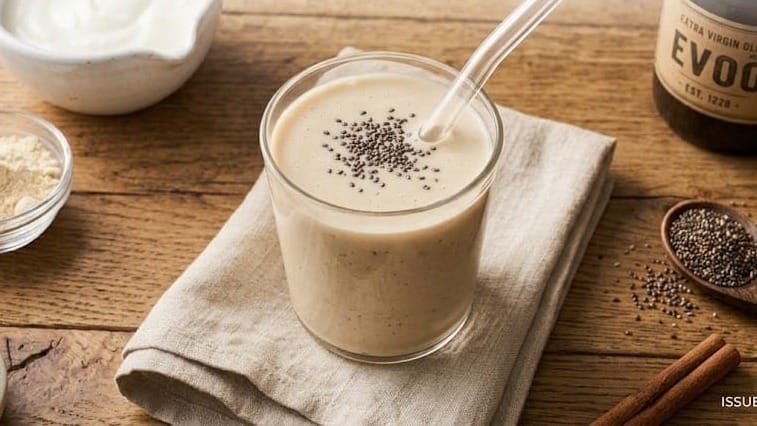
- This shake combines a handful of ingredients that are effective at stimulating the 'weight-loss' peptide hormones like GLP-1 and GIP.
- Each ingredient targets the cells in your gut and pancreas that release these appetite-suppressing hormones, for a modest amount of calories.
- When you consume the shake is nearly just as important as the ingredients in the shake itself. It needs to be timed strategically.
The weight loss peptide injections (or pills) that target hormones like glucagon-like peptide-1 (GLP-1) and glucose-dependent insulinotropic polypeptide (GIP) have transformed weight loss treatments. These drugs are designed to mimic (and amplify) the natural hormonal responses to eating, but without the calories. Together, GLP-1 and GIP are known as the "incretin" hormones.
The outward-facing "sensory" cells in your gut and pancreas are there to detect incoming nutrients. When they are exposed to and sense specific nutrients, they release peptide hormones like GLP-1, GIP and glucagon, amongst others, into your bloodstream. These hormones then help regulate your appetite and blood sugar, which is why drugs that mimic them can support weight loss.
Even if you're going to take the new weight loss drugs, you still need to eat food! So, why not try to optimise your diet first? Why not also prioritise foods that stimulate these same peptide hormones, before or alongside medication*?[1]
The aim of this article is to give you a single recipe for a drink that contains ingredients that trigger these peptide hormones as efficiently as possible (as far as natural whole foods can). We've made the recipe as quick, easy, cheap, and convenient as possible while keeping calories as low as possible.
Recipe: The GLP-1 (Incretin) Shake
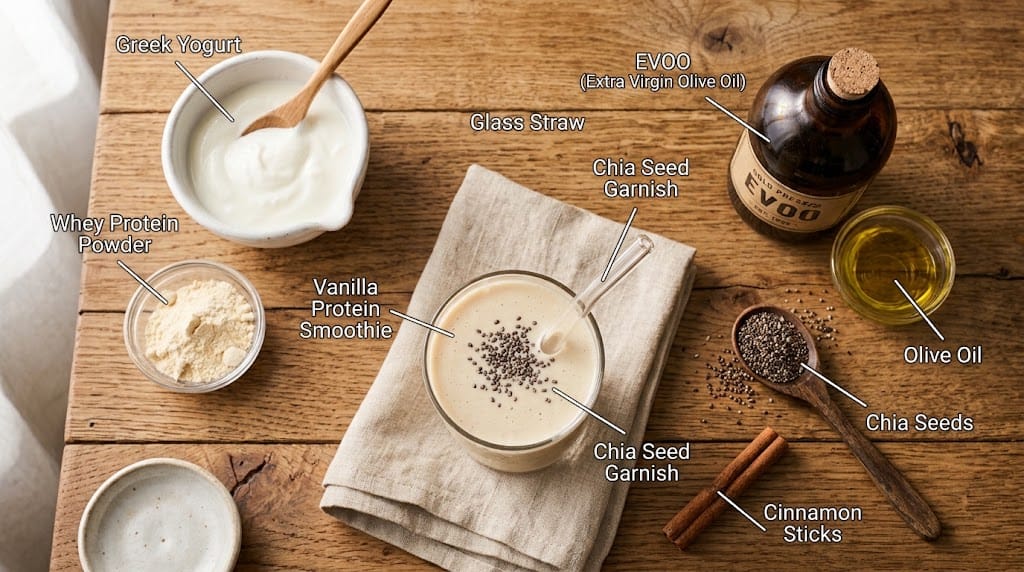
- 20 g Whey Protein Hydrolysate (unflavoured or flavoured)
- 150 g Plain Low-Fat Greek Yoghurt (or other yoghurt or kefir)
- 15 ml (1 tbsp) Extra Virgin Olive Oil
- 12 g (1 tbsp) Whole Chia Seeds
- 150 ml Cold Water (or milk or plant milk), or to your desired consistency.
- Optional Flavouring: 1/2 tsp ground cinnamon or 1 tsp raw unsweetened cocoa powder, or whatever flavouring you like to your taste.
Prep Method (active time: under 3 minutes)
- Add the cold water (or milk) and Greek yoghurt to an insulated shaker bottle (one that keeps your drinks hot or cold).
- Add 20 g of whey protein hydrolysate, 1 tbsp (12 g) of chia seeds, and cinnamon or cocoa powder (optional).
- Pour 15 ml (1 tbsp) of extra virgin olive oil directly on top.
- Add some ice cubes, secure the lid, and shake vigorously for 20–30 seconds until emulsified. The ice cubes will cool the drink but also help mix the ingredients.
- Let it sit in the fridge for 10–20 minutes before drinking. The chia seeds absorb a lot of liquid, so you can adjust the consistency at the end by adding more water or milk.
In 2026 prices the cost per serving is about £1.20 (or $1.60), but it depends on where you live and where you shop. Nevertheless, it's a fraction of the cost of weight loss pills and injections. And it's still significantly cheaper than the commercial pre-made smoothies that are now available.
While a $1.60 DIY shake won't replicate the hormone release (or physiological effects and weight loss) of synthetic drugs — that can cost hundreds of pounds or dollars a month — it does have some advantages that could be better for long-term health, in addition to the cost savings.
This type of food-first method is more gentle and works with your body's natural systems (rather than overriding them). In addition, the food-first approach provides more than a dozen essential nutrients, and it tastes good. It is safe to eat and accessible to pretty much anyone*. And we believe it is more sustainable in the long run due to the lower cost and the lower risk of side effects.
- 370 kcal · 35g protein · 12g carbs · 21g fat · 5g fibre
- Source of: Calcium, phosphorus, magnesium, manganese, vitamins E, B12, B2, leucine, essential and branched-chain amino acids, monounsaturated and omega-3 fatty acids (ALA).
- Because the shake does contain around 370 kcal, it should be used to replace a snack or part of your meal, not in addition to your normal daily intake.
Storage, Prep & Transport
Use a double-walled vacuum-insulated stainless steel shaker bottle. With ice in the bottle, it can keep the shake cold for several hours (check your bottle's rated cold retention). But if your work has a refrigerator, keep it there.
Over time, the chia seeds begin forming a viscous gel (within about 20 minutes of mixing). If you prefer a thinner, more drinkable consistency, keep chia seeds in a small dry container and toss them into the shaker 5 minutes before drinking. If you prefer a thicker, pudding-like snack eaten with a spoon, mix them in the morning and let them absorb more liquid.
*Notes on suitability and safety
This shake is suitable for most healthy adults. Avoid it if you have a milk allergy. If you have kidney disease, gut issues or swallowing difficulties, or take medication for diabetes or weight loss, you should speak to your doctor before changing your diet (or any treatment).
The Science Behind the Ingredients
#1. Whey protein hydrolysate
This is a supplement that you'll have to buy. It is a milk protein ("whey") that has been "pre-digested". This is where the long-chain polypeptides in the protein have been broken down into small peptides and free amino acids.
Why do this? These peptides and amino acids travel through your gut and get into your bloodstream very quickly, where they go on to trigger the release of GLP-1, GIP and glucagon.
Whey protein hydrolysate is a processed product. If you'd rather avoid processed products, you can replace it with more yoghurt or skyr. If you're vegan, you can use high-quality plant-protein powders (e.g., pea, soy or rice) and swap the yoghurt for a calcium-fortified soy yoghurt. If you can't get a hydrolysate or it's too expensive, you can use a whey protein concentrate or isolate instead.
Side Note: The large dose of high-quality protein can minimise muscle loss if you're aiming to lose a large amount of "weight" (really fat!). This is one of the known side effects of using weight loss injections.[2][3]

#2. Greek yoghurt: high-calcium dairy base
Low-fat yoghurt or any other strained fermented dairy — that's a good source of protein and calcium — stimulates the release of GLP-1. Calcium seems to "sensitise" the nutrient-sensing cells that release it.
So, when you combine calcium and protein (from the whey protein and yoghurt itself), you get more released than either nutrient can stimulate alone ('synergistic effect').[4]
#3. Extra virgin olive oil: monounsaturated fat
Cold-pressed extra virgin olive oil is rich in long-chain monounsaturated fatty acids — specifically 'oleic acid'. Fats stimulate gut hormone release, and oleic acid appears to be a particularly potent trigger of GLP-1. It also tastes great and has many other nutrients and health benefits.[5]
 Dr. Robert Davies
#4. Whole chia seeds: fibre and omega-3s
Chia seeds are a great source of a special type of fibre ('mucilage fibre') and omega-3 fatty acids. When chia seeds are left in liquid, they form a thick, viscous gel. You'll see this for yourself when you follow the recipe.
This gel consistency is exactly what you want. It slows down digestion of the nutrients that are within the gel, which allows them to travel further down your gut uninterrupted. This is important as the nutrients can then reach the GLP-1-releasing cells, which are at the end of the ileum and colon.[6]
Don't olive oil and chia seeds contain fat and loads of calories?
Yes, they do. Olive oil and chia are calorie-dense, but their specific fats and carbohydrates have net beneficial effects for satiety and weight loss. They slow down digestion and send "I'm full" signals to the brain.
That said, you're only eating a (relatively) small amount of them. The other question you need to ask is, "What would you be eating instead"? Crowding out 'empty calories' for ones that have health benefits and provide other nutrients is a net gain in our opinion.

When To Eat It: Timing Matters
The effectiveness of this drink can depend on when you consume it. If your primary aim is for satiety, lowering your calorie intake, and weight loss — we suggest drinking the shake 20 minutes before your main meal of the day.[7][8]
By main meal, we mean the one with the most calories. For most people (in the West), this is now their evening meal. But it could also be for your lunch as well. We call it a 'pre-load' or 'primer' because it is taken before the meal. Light starters or appetisers — like soups or salads — perform a similar function.
Why 20 minutes?
Drinking the shake 20 minutes before eating gives the nutrients time to reach the bottom of your small intestine and your colon. So by the time you start eating, GLP-1 and GIP may already be rising.
In theory, the pre-load raises GLP-1 and GIP before you start eating, slowing digestion and helping you manage your energy better, both during and after you eat your main meal. This hopefully improves fullness, controls your appetite and reduces your overall calorie intake during the meal.
Alternative timing strategies
There are other times or ways you can consume the shake.
- Eat it as a quick, portable breakfast to get you to lunch. You can add some porridge oats (and more liquid) the night before to make into a proper breakfast of overnight oats.
- If you struggle with hunger between meals — normally around 11.00 am or 3.00 pm — you can drink the shake then to keep those cravings at bay for a few hours.
- Use the shake as a substitute for those ultra-processed junk food snacks from the vending machine at work.
- Split the shake in half and drink it before both lunch and dinner. This is good if you want to reduce calorie intake at both meals or spread your calories a bit more evenly throughout the day.
Sources
- Ghusn & Hurtado. Glucagon-like Receptor-1 agonists for obesity: Weight loss outcomes, tolerability, side effects, and risks. Obes Pillars. 2024 Aug 31;12:100127. PMID: 39286601
- Alissou et al. Impact of Semaglutide on fat mass, lean mass and muscle function in patients with obesity: The SEMALEAN study. Diabetes Obes Metab. 2026 Jan;28(1):112-121. PMID: 41068996
- López-Gómez et al. Effectiveness of Whey Protein Supplementation in Weight Loss Interventions for Patients with Obesity: A Systematic Review. Nutrients. 2026 Feb 21;18(4):695. PMID: 41754212
- Watkins et al. Protein- and Calcium-Mediated GLP-1 Secretion: A Narrative Review. Adv Nutr. 2021 Dec 1;12(6):2540-2552. PMID: 34192748
- Mandøe et al. The 2-monoacylglycerol moiety of dietary fat appears to be responsible for the fat-induced release of GLP-1 in humans. Am J Clin Nutr. 2015 Sep;102(3):548-55. PMID: 26178726
- Ayaz et al. Chia seed (Salvia Hispanica L.) added yogurt reduces short-term food intake and increases satiety: randomised controlled trial. Nutr Res Pract. 2017 Oct;11(5):412-418. PMID: 28989578
- Spiegel et al. Effects of posture on gastric emptying and satiety ratings after a nutritive liquid and solid meal. Am J Physiol Regul Integr Comp Physiol. 2000 Aug;279(2):R684-94. PMID: 10938260
- Ohkuma et al. Association between eating rate and obesity: a systematic review and meta-analysis. Int J Obes (Lond). 2015 Nov;39(11):1589-96. PMID: 26100137