Why You Should Lunge: Benefits & How To Lunge
Evidence-based guide to the lunge exercise: benefits, proper form, joint-friendly variations, and how to programme lunges for strength and health

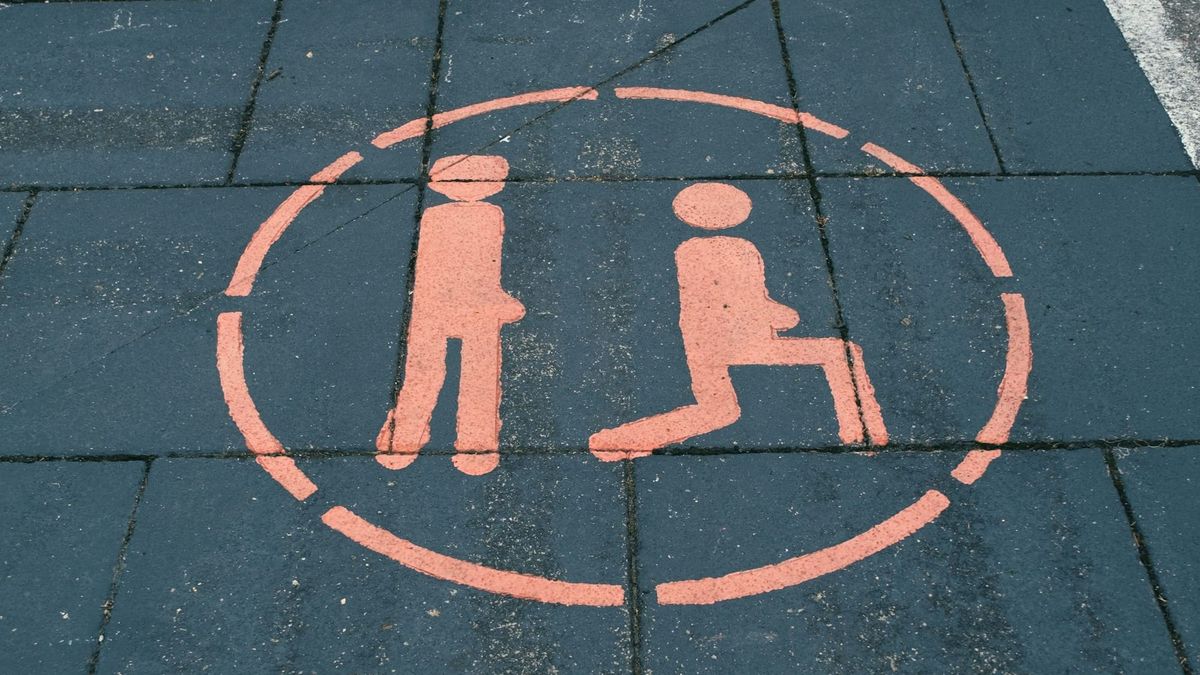
- The lunge is a "hip-extensor" movement that builds single-leg strength while keeping knee joint stress manageable under load.
- It improves balance and stability, so it can be used for athletic performance, fall prevention in older adults, and knee rehabilitation.
- Maintaining an upright torso and preventing inward knee collapse allows you to safely program lunges in your training programme.
What Is a Lunge?
A lunge is a "multi-joint" or "compound" exercise that works one leg at a time ("unilaterally"). As you step forward, just like you do when you walk, your body's muscles control the weight on one leg while shifting your centre of mass. It's intuitive to think that your quads do all the work, but your hips (especially your glutes) do a large share of it.[1][2]
During the lunge, your glutes, quads, and calf muscles work together to lower and raise your body. At the same time, your side-hip muscles keep your hips steady so you don't tilt over.[1]
But when you add external weights like dumbbells, kettlebells or a barbell, the mechanical demands (muscle work) on your hips and ankles increase. Surprisingly, knee joint stress stays fairly steady across moderate loads. Compared with two-legged exercises like squats, lunges demand more balance and single-leg hip strength. Weighted lunges may also help develop lower-body power for explosive movements like jumping.[1][2][3][4]
Movement Spec: The Lunge
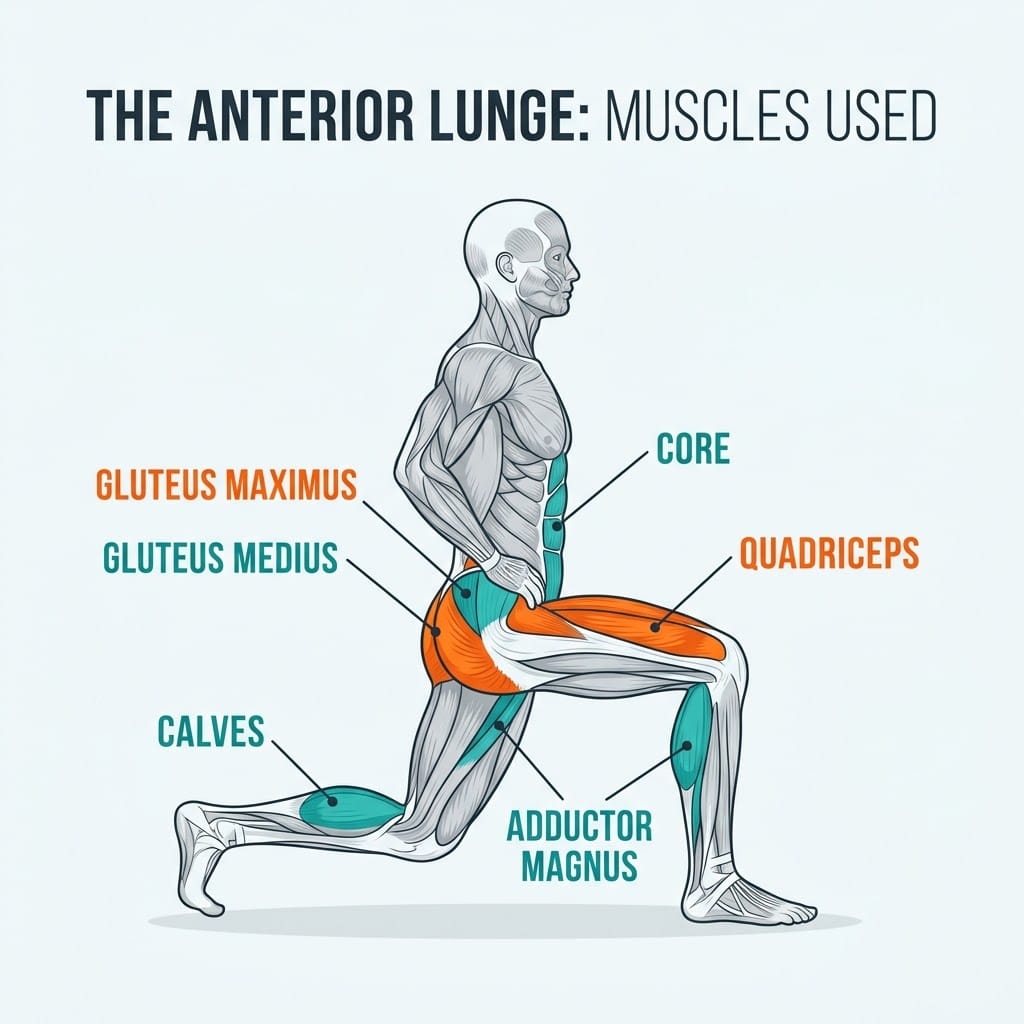
- Primary Muscles ('Movers'): Gluteus Maximus, Quadriceps (Vastus Lateralis, Rectus Femoris, Vastus Medialis).
- Secondary Muscles ('Stabilisers'): Adductor Magnus, Soleus, Gastrocnemius, Hamstrings, Gluteus Medius, and core muscles.
- Movement Pattern: Unilateral sagittal-plane step deceleration (closed-kinetic-chain).
- Equipment Options: Bodyweight, Dumbbells, Kettlebells, Barbell, and Weight Vest.
- Skill Level: Beginner to Intermediate (start with bodyweight or split squats; progress as balance and stability improve)
- Key Benefits: Hip-extensor strength, single-leg balance, fall prevention, dynamic deceleration
Should You Lunge: The Benefits of the Lunge Exercise?
Lunging mimics natural human movement, so it offers a lot of benefits that transfer over to real life. Lunges are often used in the later stages of **recovery** after knee injuries or surgery (e.g., ACL reconstruction or meniscal repair), usually under a physiotherapist's guidance. Lunging is great for rebuilding strength in the quads and glutes while training knee stability under external loading.
Lunging is also useful for older adults, as it trains the strength and balance that may help reduce the risk of falls. Stepping forward and learning to catch your body weight builds both, without any special gym equipment.[4]
Athletes also use lunging exercises to build stopping power, change direction quickly and develop explosive single-leg power for sprinting and jumping.
Lastly, lunges are sometimes included in strength-training programmes for people recovering from or living with serious conditions (e.g., cancer or Parkinson's disease) to build strength and help them regain independence.[5][6]
Troubleshooting and Common Problems with the Lunge
Good form is especially important when you lunge. A common error among beginners is letting the front knee travel too far forward and the heel lift, usually when the weight is too heavy. This shifts the load away from the hips and onto the knee, overloading it.[7]
To protect your joints, keep your chest up and your torso fairly upright, avoiding excessive forward lean or arching your lower back. Beginners should master bodyweight or light dumbbell lunges before trying heavier weights or other lunge variations.
If you have kneecap pain, deep lunges aren't ideal because they increase compression between the kneecap and the thigh bone. If you still want to lunge, reduce the depth and, if you're adding load, use a weight vest rather than dumbbells, which keeps the weight closer to your centre of mass and makes it harder to tip forward. If the pain persists, see a physiotherapist.
We advise avoiding heavy weighted lunges when your legs are really fatigued. When your hip, knee, and ankle joints become tired, they also become less stable, which increases the risk of injury.[8]
How to Do the Lunge?
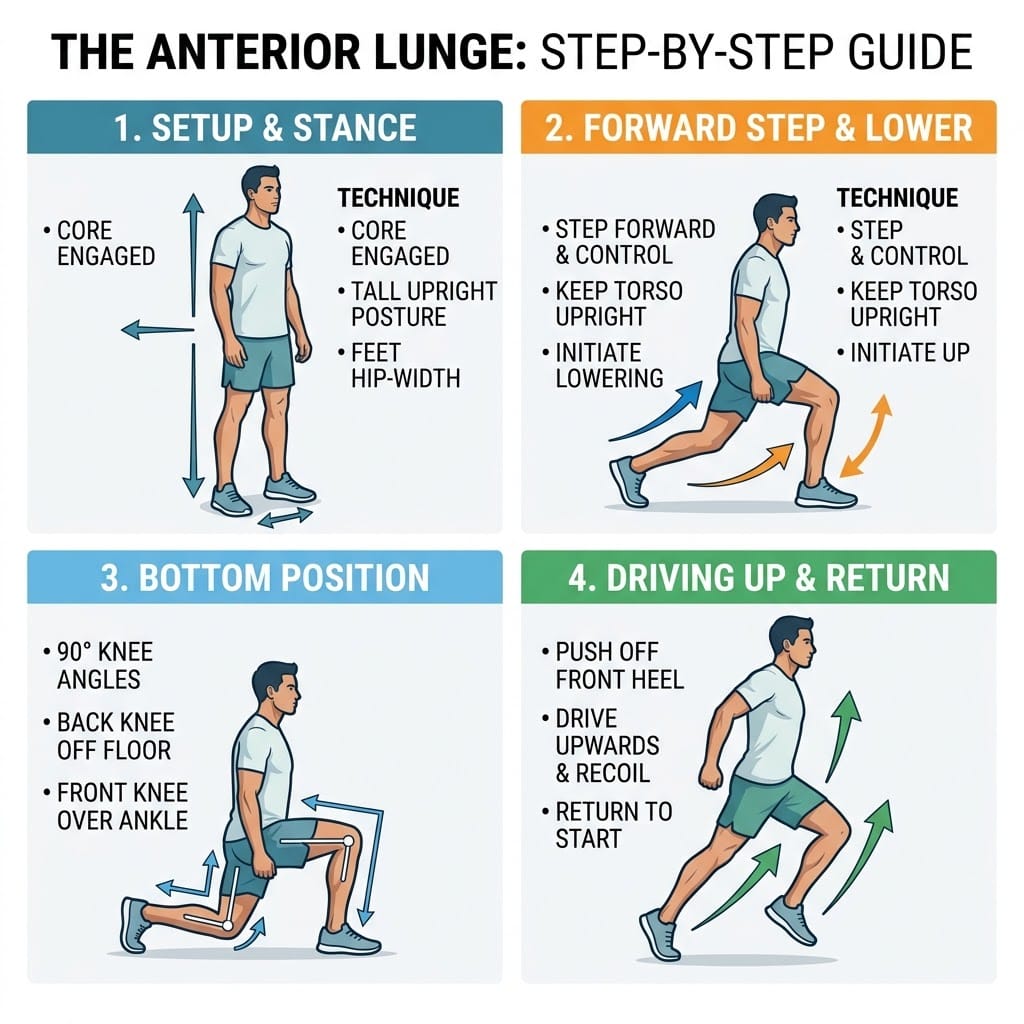
Don't overcomplicate the lunge; it is a natural movement that can be broken down into four simple steps.

- Stand tall with your feet hip-width apart and your core tight.
- Take a smooth step forward, landing with your feet hip-width apart (like railway tracks, not a tightrope). Step in a straight line, without swinging your foot out to the side or across your midline.
- Lower your hips straight down until your front thigh is roughly parallel to the floor and your back knee hovers just above it (don't bang it on the ground). Keep your front knee tracking in line with your middle toes and don't let it cave inward.
- Push firmly through your front heel and midfoot to return to your starting position in one smooth motion.
The lunge is easily adaptable. There are many variations. Beginners can start with a simple stationary lunge or "split squat", where you keep both feet fixed on the ground to remove the added "stepping" complexity.
If you have a history of knee pain, try a reverse lunge, where you step backwards instead of forward. This reduces the pressure on the knee joint while keeping a lot of the benefits. Advanced lifters can use walking lunges or weighted variations to maximise muscle growth, power and strength.
Other lunge variations
- Walking Lunge: Step forward continuously into each repetition, driving through your front heel while keeping your chest upright.
- Lateral (Side) Lunge: Step widely out to one side and push your hips back like a single-leg squat while keeping your non-working leg completely straight.
- Deficit Lunge: Place your front foot on a 5–10 cm (2–4 inch) step or stack of weight plates to increase the range of motion at your hip and knee.
- Curtsy Lunge: Step your back foot diagonally behind your lead leg, keeping your hips facing forward to target your side glutes and hip stabilisers.

How to Do More Lunges
If you want to get the benefits of lunging, the easiest way to programme them is to add them to your lower body split or whole body sessions twice a week. A basic 2-3 sets of 5-15 reps per leg is fine. Once you've mastered the exercise, you can gradually add dumbbells, kettlebells or a weighted vest to externally load the exercise and make it harder.
Do heavier lunges first, while you're fresh, or use lighter loads if you place them after your main lift (e.g., squat or deadlift). Avoid heavy lunges at the very end of the session when your legs are really tired.
Sources
- Gao et al. Influence of Different Load Conditions on Lower Extremity Biomechanics during the Lunge Squat in Novice Men. Bioengineering (Basel). 2022 Jun 22;9(7):272. PMID: 35877323
- Riemann et al. Biomechanical analysis of the anterior lunge during 4 external-load conditions. J Athl Train. 2012 Jul-Aug;47(4):372-8. PMID: 22889652
- Doma et al. Lunge exercises with blood-flow restriction induces post-activation potentiation and improves vertical jump performance. Eur J Appl Physiol. 2020 Mar;120(3):687-695. PMID: 32006099
- Flanagan SP, Wang MY, Greendale GA, Azen SP, Salem GJ. Biomechanical attributes of lunging activities for older adults. J Strength Cond Res. 2004 Aug;18(3):599-605. PMID: 15320687
- De Backer et al. High-intensity strength training improves quality of life in cancer survivors. Acta Oncol. 2007;46(8):1143-51. PMID: 17851864
- Nocera et al. Effects of home-based exercise on postural control and sensory organization in individuals with Parkinson disease. Parkinsonism Relat Disord. 2009 Dec;15(10):742-5. PMID: 19640769
- O'Reilly et al. Classification of lunge biomechanics with multiple and individual inertial measurement units. Sports Biomech. 2017 Sep;16(3):342-360. PMID: 28523981
- Gao et al. Biomechanical effects of exercise fatigue on the lower limbs of men during the forward lunge. Front Physiol. 2023 Aug 17;14:1182833. PMID: 37664426