Strength vs. Size: How Your Muscles Really Adapt to Training
Early strength gains come from your nervous system, not bigger muscles. Here's how hypertrophy and neural adaptation actually work.

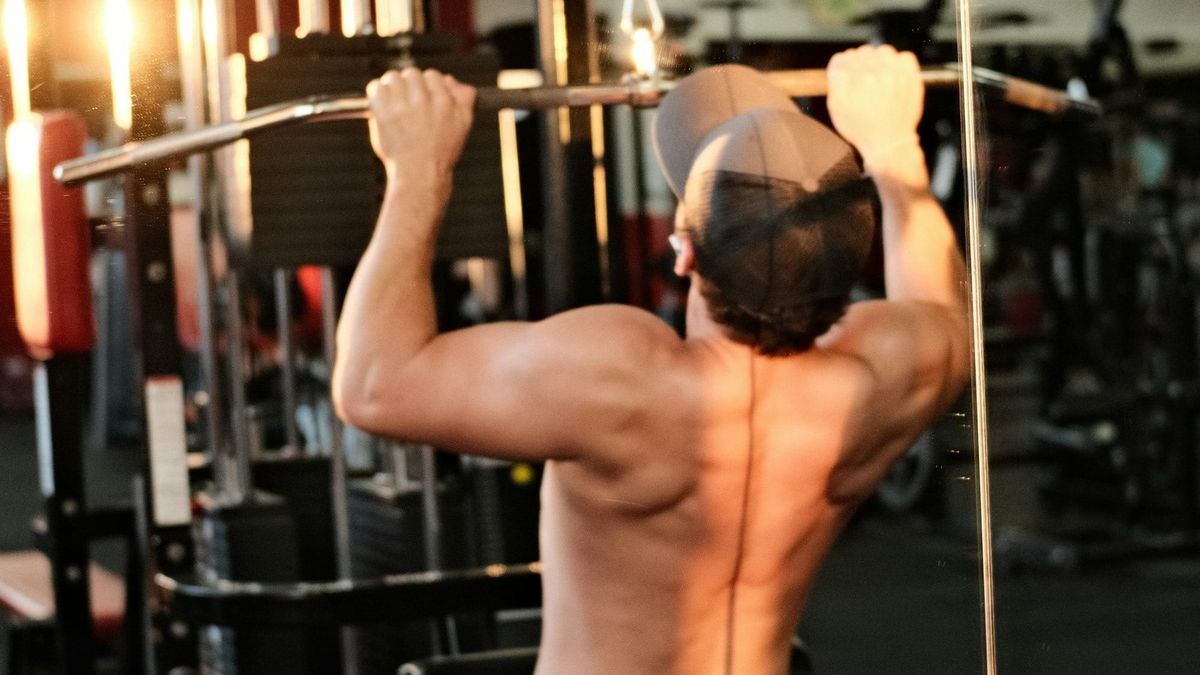
- Hypertrophy is the enlargement of muscle cells that you have, not new ones being created. This is what happens when you start lifting weights.
- The strength gains that you get straight away (mostly) come from your nervous system working more efficiently, not your muscles getting bigger.
- Over time, both your nervous and muscular systems adapt, getting bigger and stronger. However, they do this at different speeds.
Muscles don't grow if they don't contract. If a muscle just sits there, passively receiving nutrients and hormones from your body in normal but adequate amounts, it may still lose some of its size — and it certainly won't get any larger.
But getting stronger and getting bigger aren't quite the same process, and understanding the difference between them can help you train more effectively, recover better, and make steady, long-term progress.
The Nervous and Muscular Systems
The nervous system controls when, where, how long, and how forcefully your muscles contract, so it's the nervous system that lays the groundwork for muscle growth. This relationship is referred to as "neuromuscular" (i.e., nerve + muscle) function.
So, when your neuromuscular system becomes better and more efficient at contracting muscles, that's called a "neuromuscular adaptation." It's the reason professional weightlifters can often lift far more than bodybuilders despite having visibly smaller muscles.
The neuromuscular system has two parts: the "central nervous system" (CNS) — your brain and spinal cord — and the "peripheral nervous system" (PNS), which connects the CNS to your muscles via what's called "motor neurons". A motor neuron, together with the muscle fibres it controls, is called a "motor unit," and each muscle contains hundreds of them.
When your brain initiates movement, it sends a signal down the spinal cord and through a motor neuron, causing the muscle to contract — this is called a single "twitch." Enough twitches close together produce a "contraction", and coordinating contractions across muscles around a joint is a movement.
Lifting light weights only requires a few motor units. Lifting something heavier means "recruiting" more of them. Each motor unit can only produce so much force, so the maximum weight you can lift is capped by the combined force of every motor unit available. But, in practice, you can never fully activate all your motor units at the same moment, even during a maximal lift (e.g., 1RM).
Early adaptations: Strength without size
In the early stages of a resistance training program, your strength gains will typically outpace visible muscle growth gains. These early strength gains aren't from your muscles getting measurably bigger — they come from your neuromuscular system getting better at contracting and coordinating those muscles. This is a pattern often seen in both novice trainees and experienced athletes.[1]
As coordination and movement efficiency improve (what scientists call "motor pattern" learning), you become able to contract and control your big and fast type II muscle fibres more quickly and easily, letting you produce more force, more power, and move more efficiently overall.
It's a common misconception that neuromuscular adaptation is confined to these early weeks. While the neuromuscular changes happen fastest early on, adaptation continues well beyond the newbie phase, just at a slower rate.[2]
This happens because the brain and spinal cord become more efficient at sending signals to the muscles, and muscles and nerves that work together often become progressively better "wired" to one another. It's like how repeating the alphabet enough times means you stop having to consciously think about it and can just do it automatically.[3]
Your body also has hardwired, largely involuntary "safety systems" that limit how much force you can produce to prevent you from injuring yourself. However, as your muscles and connective tissue get stronger and movements become more familiar and less painful, you're gradually allowed a bit more freedom to produce greater forces. That's the basics of getting stronger!
Beyond driving muscle growth, improved strength and movement efficiency also brings its own indirect benefits: better injury prevention, athleticism, balance, coordination, and easier everyday activities — benefits you tend to only notice once you lose them, whether to age or injury.
Maintaining strength and functional capacity is also central to healthy ageing, quality of life, and independence. You're never too old to get stronger; studies have shown that even 90-year-olds can double their strength through resistance training.[4]
Neural, Muscular or Neuromuscular: What's the difference?
- Neural: Co-ordination, muscle activation, muscle fibre recruitment.
- Muscular: Hypertrophy, tendon stiffness, muscle fibre type.
- Neuromuscular: Power, explosiveness, strength and endurance.
What Is Hypertrophy?
The technical term for muscle growth is hypertrophy. So when a muscle grows and gets bigger, what's actually happening? Are the cells getting bigger? Yes. Are you growing more cells? No — muscle cells increase in size, not number.
That distinction matters: hypertrophy means cell growth, while hyperplasia means the creation of new cells. Hyperplasia does occur in other organs and animals. But when muscle grows in human adults, it's hypertrophy, not hyperplasia.
Hypertrophy, alongside strength gains, is the primary adaptation resistance training aims to achieve, and it results from mechanical "loading" or "tension" — most efficiently produced through resistance exercise and weightlifting.
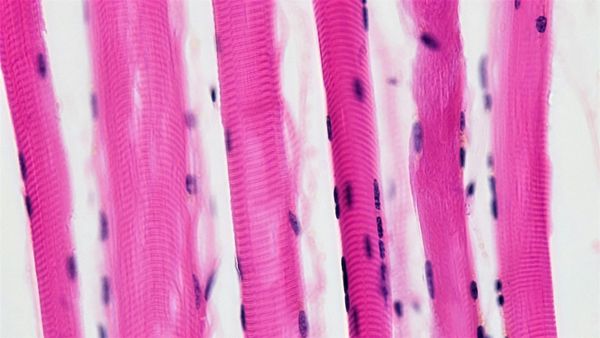
Weight training stimulates the individual muscle fibres ("myofibrils") to grow, increasing the muscle's cross-sectional area (CSA) along with its total mass and protein content. Following a solid 12-week resistance training program and a sensible diet, a typical beginner might gain 1–2 kg of muscle, with CSA increasing by roughly 5–10%.[6]
The reverse process, "muscle atrophy" that occurs during disuse or illness, can happen surprisingly fast and severely, with losses of 10–15% of muscle mass and size possible over the same 12-week window. Put simply, you can lose muscle considerably faster than you can gain it.
Myofibrillar vs. Sarcoplasmic Hypertrophy
There are two recognised types of muscle hypertrophy: myofibrillar and sarcoplasmic.
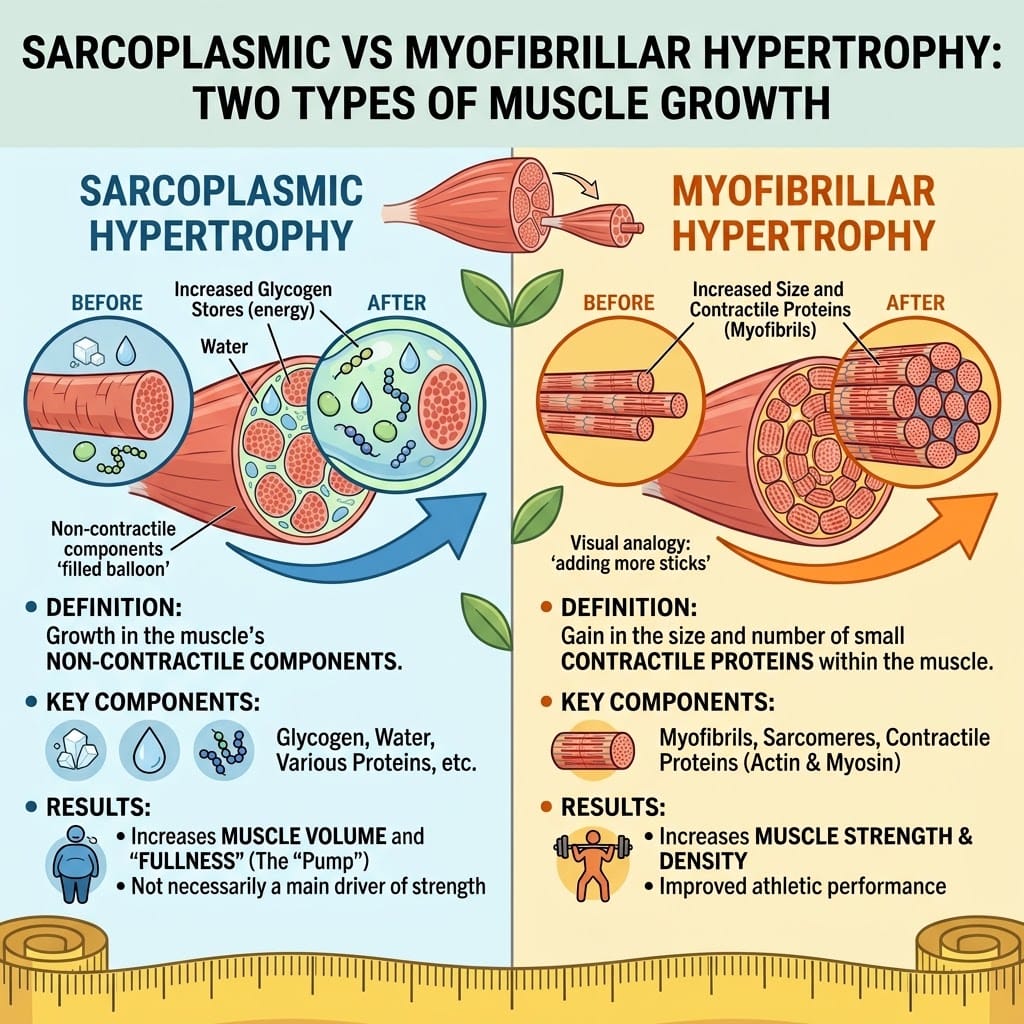
- Myofibrillar hypertrophy involves a gain in the size and number of the small contractile proteins within the muscle, which also increases muscle strength and density.
- Sarcoplasmic hypertrophy instead involves growth in the muscle's "non-contractile components" like the amount of glycogen, water, and various proteins you have in the muscle.
Sarcoplasmic hypertrophy doesn't directly increase strength, but it may improve training performance by boosting muscle size, endurance, and energy storage capacity. In reality, both types of muscle growth occur together, just at different rates, and it's unlikely either can be selectively targeted through specific diets or training styles (whether that's volume, intensity, or recovery periods).
The 3 stimulators of hypertrophy
Hypertrophy is driven by three overlapping mechanisms: mechanical tension, muscle damage, and metabolic stress.
- Mechanical tension is the force placed on muscle fibres during weightlifting — moving heavy weight through a full range of motion, under control, creates high tension in the muscle. This is where you can usually feel the muscle "hardening" when you flex it. This tension is what triggers the signalling pathways behind muscle growth.
- Muscle damage results from microtears in muscle fibres, particularly during unaccustomed eccentric exercise, and stimulates the repair processes in your body. This includes the "growth factors" that drive muscle fibre repair and regenerate your muscle fibres.
- Metabolic stress comes from the build-up of byproducts from exercise, like lactate and hydrogen ions, along with cell swelling, after moderate-to-high-intensity training, and is also associated with stimulating growth.
While all three mechanisms can contribute to hypertrophy, most researchers agree that mechanical tension is the most important of the three by far. Under normal conditions, muscle damage and metabolic stress can't signal growth without mechanical tension present alongside them — you can't really have one without the other.[7][8][9]
Hypertrophy Recommendations
- Load: 75–80% 1RM or 8–10 RM
- Reps: 8–10 or near failure
- Sets: 2–3 per exercise, 3–6 per muscle group
- Rest: 1–3 minutes between sets, 48+ hours between sessions
- Frequency: 2–3 sessions per muscle group per week
Individual variation
How much any person responds to resistance training varies with genetics, training history, effort, nutrition, and recovery. Some people see rapid gains ("high responders"), while others progress more slowly. In practice, nearly everyone is a responder to some degree and can achieve measurable muscle growth with consistent training.
Why this matters beyond the gym
Hypertrophy is foundational to nearly everyone's fitness goals. It improves metabolic health, increases "insulin sensitivity", supports joint stability, and slows age-related loss of muscle mass (sarcopenia).
In addition to the broader benefits of neuromuscular adaptation (mentioned above), it comes with better balance, coordination, and lower injury risk. Training for both size and strength is a cornerstone of long-term health and athleticism, whatever your primary goal happens to be: aesthetics, athletic performance, or simply ageing well.