Muscle Fibre Types Explained: Growth and Function
Not all muscle is created equal, and neither are muscle fibres. Learn more about how they move, look, produce energy and behave.

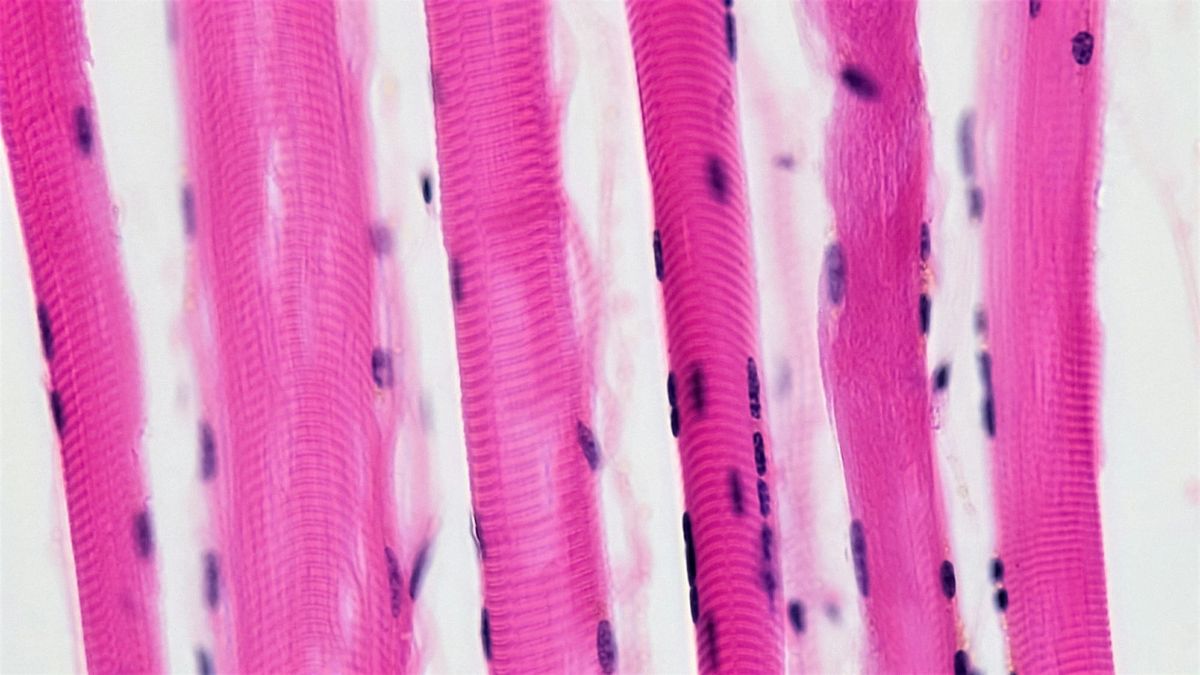
- There are three distinct muscle fibre types: Type I ("slow-twitch"), Type IIx ("fast-twitch") and Type IIA (also "fast-twitch")
- They have different characteristics: the way they look, move, produce energy and behave, which is what differentiates them.
- The type of muscle fibres you have is determined by genetics, the type of muscle they're in, and what and how much training you do.
Beneath the surface of your skin lies a complex system of different types of muscle cells. Each type has distinct characteristics that influence how we move, respond to training, and grow muscle. Understanding the role of these muscle cell types helps explain why muscle growth differs between people — and why it even happens at all.
What are the Different Muscle Fibre Types?
Because they are long and thin, like a piece of string, human muscle cells are referred to as “muscle fibres”, and there are two main types: Type I and Type II. Type I is sometimes called “slow-twitch” and Type II is called “fast-twitch”. The Type II fibres (in humans) are then further divided into Type IIA and IIx, which is sometimes referred to as IIB in other mammals.
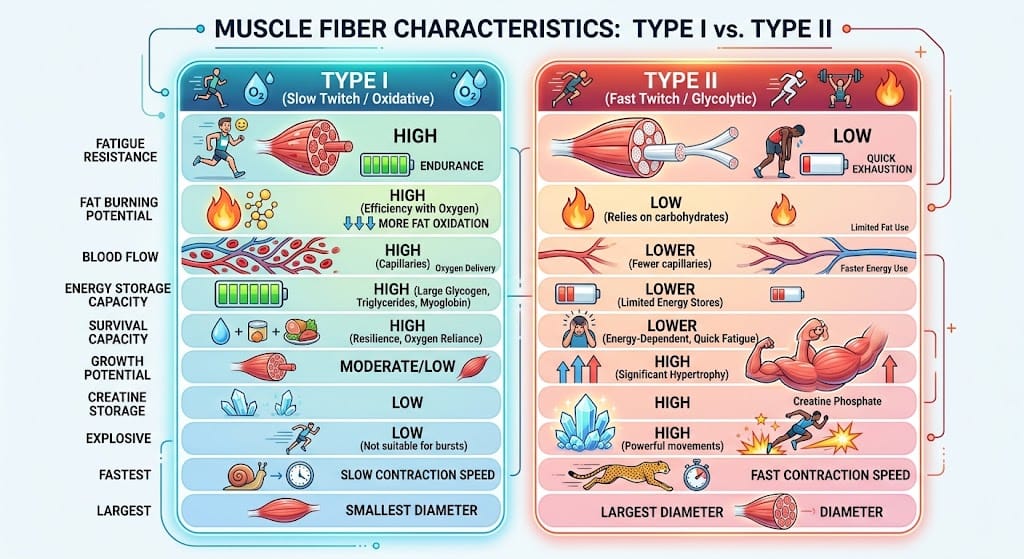
They are divided like this because they have different characteristics — the way they contract, the amount of force they produce, and even the way they look under a microscope. The Type I fibres contract slowly and don’t fatigue very quickly — making them well suited for low and slow “endurance” exercise like long-distance running, cycling, or swimming. But contrary to common belief, they are only slightly smaller than the "fast" Type II fibres, and they can also grow (albeit slower than Type II).
Type IIx fibres are strong and fast, and very powerful, but they fatigue quickly and also grow quickly in response to resistance training. The Type IIA fibres are somewhere in the middle of the Type I and Type IIx — think about Type IIA as the "athlete's" muscle fibre, strong but also has good endurance.
Type I fibres are rich in mitochondria, capillaries, and myoglobin. This makes them highly efficient at using oxygen to produce energy. Hence, they are sometimes referred to as “oxidative” muscle fibres. Whereas the Type II fibres, especially Type IIx, have fewer mitochondria and capillaries, so they fatigue more quickly. That said, the Type II fibres can produce more force and power because they are slightly larger and contract more quickly.[1]
Characteristics of Type I and Type II Muscle Fibres
Different Muscle Fibre Types: Variations
The composition of the different muscle fibre types varies between people and across muscles and muscle groups. In response to resistance training and/or endurance training, a small amount of Type IIx can change to Type IIA. Type I to Type IIA interchange is less common, but possible. And Type IIA (not IIx) to Type I conversions only occur in response to endurance training.[2]
Genetics plays the most significant role in determining muscle fibre type, so the composition of the millions of muscle fibres in different muscles and different people varies substantially. The thigh muscle of an elite marathon runner may contain up to 70% Type I (and 30% Type II) muscle fibres. Whereas a sprinter's or weightlifter's thigh may contain only 30% Type I (and 70% Type II).[3][4]
The same variation is seen across different muscles even in the same person! One of the muscles in the calf (soleus) can contain up to 80% Type I fibres, whereas another calf muscle (gastrocnemius) contains only half that amount. Different fibre types also have varying potential for growth. This is why different muscles (and different people) respond differently to the same training. Some muscles grow quicker than others.
The mixture of Type I and Type II fibres in each muscle isn’t just random or homogeneous across the entire muscle. Different regions of the same muscle have distinct fibre types. For example, deeper layers in the muscle (closer to the bone) may have a higher amount of Type I fibres. Whereas the muscle near the surface of the skin has more Type II fibres. Confusingly, there are also “hybrid” fibres, which contain a mixture of both Type I and Type II components.
We'll leave it at that for now.
Muscle Growth & Muscle Fibre Types
Understanding muscle fibre types can help you train more effectively. Whenever you move, the nervous system “recruits” (or contracts) the amount of muscle fibres it needs, based on how much force is required. It's similar to supply and demand in economics — in muscle biology, it's called 'the size principle'.[5]
Lifting a very light weight only a few times “recruits” a small amount of muscle fibres, mainly Type I first. Whereas lifting a heavy weight, with high effort, “recruits” a lot of the muscle fibres almost immediately — both Type I and Type II.
But lifting a light weight, a lot of times, with a lot of effort also recruits a lot of muscle fibres — both Type I first and then Type II if and when needed. This means you don’t always need heavy weights to activate those Type II fibres — but you do need a lot of reps and effort, usually by pushing close to failure. So if you want to optimise muscle growth, either lift heavy or take light weights close to failure
What is the Size Principle?
Muscle growth depends on recruiting as many muscle fibres as possible. According to the size principle, small fibres are recruited first, then followed by larger fibres as effort and fatigue start to increase.
Heavy loads recruit more fibres, but low loads taken to failure also recruit more fibres. Muscle growth is only stimulated when the fibre is "recruited" (or working). So, heavy weights or high-rep sets to exhaustion ensure nearly all muscle fibres are stimulated to grow.[6]
Summary
Three distinct muscle fibre types exist: Type I (slow-twitch), Type IIA, and Type IIx (fast-twitch). Each fibre type has different characteristics for contraction speed, force production, fatigue resistance, and growth potential. The distribution of the different fibre types in your muscle depends on your genetics, what muscle you're looking at, and what training you're doing.
Endurance athletes tend to have more Type I fibres. Power athletes tend to have more Type II fibres, though composition can change slightly with training. So, understanding recruitment patterns can be used to optimise training. Light weights recruit mainly Type I fibres, while heavy weights or training to failure recruit both Type I and Type II fibres for maximum growth stimulus.

Sources
- Schiaffino S, Reggiani C. Fiber types in mammalian skeletal muscles. Physiol Rev. 2011 Oct;91(4):1447-531. PMID: 22013216
- Plotkin DL et al. Muscle Fiber Type Transitions with Exercise Training: Shifting Perspectives. Sports (Basel). 2021 Sep 10;9(9):127. PMID: 34564332
- Tesch PA, Karlsson J. Muscle fiber types and size in trained and untrained muscles of elite athletes. J Appl Physiol (1985). 1985 Dec;59(6):1716-20. PMID: 4077779.
- Trappe S et al. Skeletal muscle signature of a champion sprint runner. J Appl Physiol (1985). 2015 Jun 15;118(12):1460-6. PMID: 25749440
- Henneman E et al. Functional significance of cell size in spinal motoneurons. J Neurophysiol. 1965 May;28:560-80. PMID: 14328454
- Lopez P et al. Resistance Training Load Effects on Muscle Hypertrophy and Strength Gain: Systematic Review and Network Meta-analysis. Med Sci Sports Exerc. 2021 Jun 1;53(6):1206-1216. PMID: 33433148