How to Build Muscle: The Basic Blueprint for Beginners
An overview of the core principles of muscle hypertrophy. Learn how training, nutrition, and recovery drive muscle growth.


- Train each muscle group 12–20 working sets per week across at least 2 sessions, finishing each set 1–3 reps short of failure.
- Consume 1.4–2.0g of protein per kg of bodyweight daily, distributed across 3–6 meals and snacks.
- Eat 30–50 kcal per kg of bodyweight daily, sleep 7–9 hours per night, and allow 48+ hours of rest between sessions.
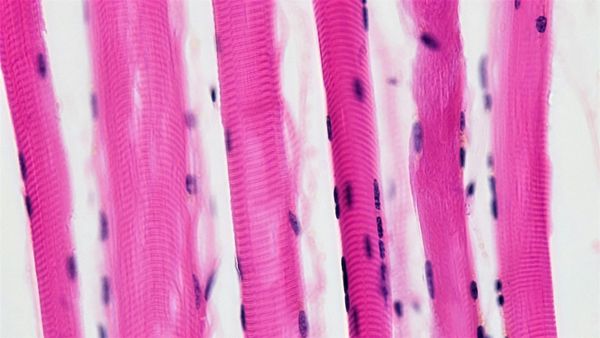
Building muscle (also known as muscle "hypertrophy") works by increasing the size of your individual muscle cells, usually via specific training and nutritional strategies. This article explains the fundamental evidence-based muscle-building principles for beginners.
The truth is, effective muscle growth follows well-established scientific principles that have been validated through decades of research and centuries of practice.
You don’t need complicated programmes, expensive supplements, "secret" techniques, hacks, or fancy equipment to build muscle. In this article, we've created a short evidence-based checklist that distils muscle growth down to the fundamentals.
How hard to train to build muscle?
How close you get to your maximum capacity (sometimes referred to as "muscular failure") is one of the strongest predictors of muscle growth. Finishing the set within a few repetitions of failure is best for growth.[1]
Why Train Hard? When you train to (or near) failure, you start to use more of your muscle cells (or muscle "fibres"). This creates the mechanical tension needed to stimulate the most growth in the most muscle fibres possible. This doesn’t mean every set needs to be taken to complete failure, but each of your “working sets” should challenge you.
Practical application:
Aim to finish each set feeling like you could only complete 1–3 more repetitions with good form. Use measures like the RPE ("Rating of Perceived Exertion") or RIR ("repetitions in reserve") to gauge your effort level.
The key here is to progressively "overload" your muscles, which just means gradually increasing the amount of work they are doing over time. This can be done by adding more weight, doing more repetitions, or doing more difficult exercises, while maintaining the same amount of (high) effort.
How much should you train to build muscle?
Volume per session also matters for muscle growth. Performing multiple sets per exercise is generally better than a single set. To achieve weekly volume targets, you’ll probably have to do at least 3 sets per muscle group per session.[2]
Multiple sets allow you to accumulate greater mechanical tension and metabolic stress in the muscle — two key drivers of hypertrophy. If you have time, you can do up to 12 sets per muscle group, as long as you can still hit your target loads throughout the session.
The mid-range of about 6 sets per muscle group per session using 2–3 different exercises is most common.
Practical application:
Structure your workouts to include 3–12 working sets for each major muscle group you’re targeting that day. This could be across 1–6 different exercises. This might seem lower than most recommendations, but consider that warm-up/ramp-up sets don’t count toward this total. Only sets performed at high intensity (near failure) qualify as “working sets”.
Rest periods between sets should be enough to maintain performance without wasting precious time. Usually, this is 1–3 minutes, depending on personal preferences and your recovery time.
How often do you have to train each muscle group?
Weekly training volume is the total number of working sets performed per muscle group across all sessions. It is one of the strongest predictors of muscle growth; 12 to 20 sets per muscle group per week will optimise muscle growth for most people.[3]
This range allows an adequate growth stimulus while avoiding "excessive" fatigue, which just prolongs recovery and wastes time (without adding any extra muscle growth). Beginners may start to see good results with even lower volumes. Older adults may benefit from higher weekly volumes.
Practical application:
Track your weekly sets for each major muscle group. Remember that “compound” movements (e.g., deadlift, squat, bench press) count as multiple muscle groups being worked at the same time.
What is the best training split for muscle growth?
Training frequency (how often you train each muscle group) also seems to affect muscle growth. Training each muscle group 2 (or more) times a week is better than once a week.[4]
If you train more often, you can also distribute your weekly volume across multiple sessions. This allows for more recovery, which generally means better training performance and technique, and thus more efficient muscle growth.
Practical application:
Design your training split to hit each muscle group at least twice per week. This could be:
- 2 full-body sessions (2 sessions total)
- 1 lower body + 1 upper body + 1 full body (3 sessions total)
- 2 upper body + 2 lower body (4 sessions total)
This advice may contrast with the traditional 1 muscle group per week split. However, remember that the number of sets per muscle group per session is lower (as few as three). Also, remember that multiple muscle groups can (and should) be worked in a single session, and compound exercises count as working more than 1 muscle group at a time.
How many muscle groups are there?
There are over 600 muscles in the human body, and scientists have grouped them in dozens of different ways. There is no grand consensus. So, for movement and muscle growth, it might be useful to think about splitting your body into 4 major muscle parts.
Divide your body into the upper body and the lower body (split at the waist). Then divide your upper and lower body into pulling and pushing muscle groups again.
- Bench press, overhead press, dips and triceps extensions are upper-body push movements that target the chest, shoulders and triceps.
- Rows, pull-ups, hang power cleans and bicep curls are upper-body pull movements that target your back and biceps.
- Squats, leg press and calf raises are lower-body push movements that target your quadriceps and calves.
- Deadlifts and hamstring curls are lower-body pull movements that aim to target your hamstrings and glutes.
If you're doing big compound free-weight movements, you're rarely working any muscle group in complete isolation.
Some "push" exercises (e.g., bench press) also work "pull" muscles (e.g., lat muscle), although to a lesser degree. Some muscles (e.g., glutes and abs) are fully working in both "push" and "pull" exercises (e.g., squat and deadlift).
So, splitting the body up this way is not an exact science; it is just a way to ensure that you're working all major muscle groups, every week, somewhat equally.
How long to rest to build muscle?
Recovery between training sessions is crucial for growth. The muscle growth processes remain elevated for 24+ hours after training. So, an adequate amount of rest is needed for repair and growth to occur optimally.
Training a muscle repeatedly whilst it is fatigued and sore can impair growth, increase injury risk and lead to overtraining. Delayed onset muscle soreness (DOMS) is an indicator of incomplete recovery, although simply "not having any DOMS" doesn't mean you are fully recovered either.
Persistent soreness, poor performance, or feelings of fatigue may indicate that you're not getting enough rest.
Practical application:
If you're training at a high level of effort, allow 1 full day (or at least 48 hours) between training sessions. There is little point in training for growth when fatigued or sore.
So if you trained your chest on Monday morning, avoid heavy pressing movements until Wednesday afternoon. If you are still sore and unable to hit the target weights on Wednesday, stop, do something else, and give yourself more time to rest.
A bit of light movement and active recovery are fine and can actually be beneficial, but avoid any high-intensity training of the exercised muscles. Track your performance and soreness levels. If you’re consistently weaker or experiencing persistent soreness, consider adding an extra rest day or reducing training volume temporarily.
How much sleep do you need to build muscle?
Sleep is when the majority of muscle growth occurs. During deep sleep, anabolic hormone levels peak, muscle growth processes accelerate, and the repair processes run at full pace. Poor sleep impairs muscle growth and your recovery (which goes on to impair your growth prospects further).
Quality matters as much as quantity. Sleep should be continuous, deep, and restorative. Poor sleep quality can blunt the anabolic response to training, even if the total amount of sleep appears adequate.
Practical application:
Read our full (free) evidence-based articles on optimising your sleep, which cover what to eat and what to do for better sleep, how long, what position, and what to look out for.


How much protein do you need for muscle growth?
Protein intake is fundamental for muscle growth; you can't build muscle without it. Protein provides the amino acid building blocks your muscle needs to grow.
Protein intakes of 1.4–2.0 grams per kilogram of body mass daily are probably optimal for muscle growth when training. Distribution matters as well. Spreading protein across 3–6 meals throughout the day increases your chances of getting enough protein throughout the day.[5]
Practical application:
For a 75 kg person, aim for 104–150 grams of protein a day. Distribute it across 3–6 meals and snacks, targeting 20–50 grams every time you eat. Include protein sources at breakfast, lunch, dinner, and snacks (e.g., pre-bed, pre-workout, post-workout or between main meals).
What protein do you need to build muscle?
Protein quality (i.e., the amino acid profile and its digestibility) probably affects muscle growth as well. Animal proteins are generally “complete,” meaning they contain all essential amino acids in optimal ratios for muscle growth.
Plant proteins often require combining different sources to achieve complete amino acid profiles. "Leucine" content of the protein is particularly important, as it acts as a key trigger for muscle growth. Animal proteins typically provide higher leucine content per serving compared to most plant proteins.