What is Delayed Onset Muscle Soreness (DOMS)?
DOMS is a muscle soreness that occurs 12–48 hours after intense or unfamiliar exercise, caused by microtears in your muscle fibres.


- DOMS is muscle soreness that occurs 12–48 hours after intense or unfamiliar exercise, caused by microtears in your muscle fibres.
- It triggers inflammation and repair processes, particularly after you've done a lot of eccentric (lengthening) contractions.
- DOMS isn't required for growth, but the inflammatory response aids repair. Activity recovery, nutrition and rest can help you manage it.
If you’ve woken up a day or two after a tough workout feeling a dull, aching soreness in your muscles, you’ve experienced what is commonly known as Delayed Onset Muscle Soreness (DOMS for short).
For many people who are trying to grow their muscles, DOMS can be an expected part of training. But what exactly is happening in your muscles? Is it good or bad? Can you fix DOMS, or should you leave it be? We'll try to answer some of these questions in this article.
What is DOMS?
DOMS typically occurs 12–48 hours after unfamiliar and "intense" physical activity. Particularly, after exercises involving “eccentric” muscle contractions, where the muscle lengthens under force (e.g., walking downstairs, lowering the weight during a bicep curl).[1]
This soreness differs from "acute" exercise pain. It doesn't happen straightaway (hence the D for "delayed" in DOMS). It's distinct from the sharp, intense pain of getting injured during training. DOMS is different, as it generally gets worse long after you’ve left the gym.
DOMS is caused by “microtrauma” and biochemical imbalances that are inflicted on the muscle while you're exercising. This damage disrupts the structure of the muscle cells and the connective tissue that surrounds them.[2]
The initial mechanical "strain" to your muscle is caused by lifting and lowering the weights, which triggers inflammation and the release of molecules that stimulate pain signals to your brain. However, this inflammatory response is thought to also play a central role in stimulating muscle growth and repair.
Your muscles respond to microtears by activating your “satellite cells”. These special cells then go on to accelerate the repair and growth process in your muscle. The connection between muscle damage, inflammation, and regeneration underscores why DOMS is sometimes considered a marker of an effective workout, meaning that your muscles are adapting.
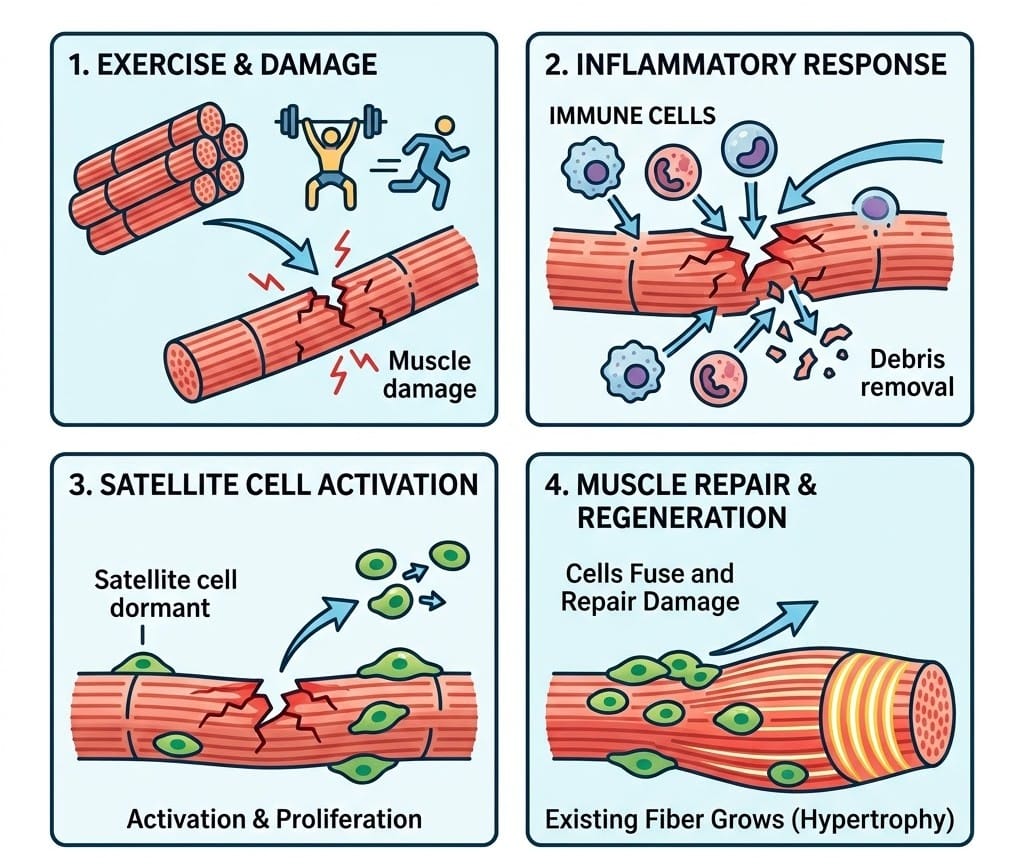
However, it's important to clarify that experiencing DOMS is not required for muscle growth. No pain doesn’t mean no gain. No DOMS doesn't mean no growth. You can stimulate growth with or without DOMS, as the principal driver of growth is mechanical tension (and maybe a bit of metabolic stress), not pain.[3]
The severity and duration of DOMS can vary between different people, different muscles, and different workouts. There are several factors that influence it.[4][5]
- Novel types of exercise, greater loads, intensities, and volumes typically lead to more muscle soreness.
- “Eccentric” muscle contractions generally cause more severe DOMS than “concentric” (muscle shortening) contractions
- Training age: Experienced lifters tend to experience less severe DOMS as their muscles have adapted to training. This is known as the “repeated bout effect”.
- Genetics & Age: Older adults tend to recover more slowly, and there are some genes that can either speed up or slow down recovery.
How To Tell the Difference Between Injury and DOMS?
Signs that it's an injury!
- Localised to a single region
- Immediate pain and soreness
- Last weeks
- "Sharp" pain
Signs that it's DOMS
- Localised to the working muscles
- Delayed onset of soreness (doesn't happen straightaway)
- Lasts a few days, then starts to get better
- "Stiff" and "achy" pain
How to Manage DOMS
This is a common problem for anyone who is serious about training hard and training regularly. While soreness is a natural part of the adaptation process, excessive soreness can hinder performance and motivation.
The science offers mixed messages on different types of recovery methods, for example:[4]